Showing posts with label Cost. Show all posts

Wednesday, September 24, 2014

Digital Signage, Need to Know: Importing LED Signs From China, Re-visited


China sourcing is alive and well, and when properly designed, controlled and managed, products made in China can be very impressive. But,  any serious American company utilizing China as their manufacturing source will have an on-site quality engineer, or preferably an engineering and production support team because with China “you get what you inspect, not what you expect”.

Apple does not phone in a sales order to its Chinese factory for 1,000,000 new iPhones, whatever the next generation, then sit around and drink wine and play ping pong until the boat arrives. 

Let’s face it, for today, China still has a “cost of labor” advantage. But, it’s rising fast, and sometimes when you factor in shipping, communication costs, and hassle, many companies are starting to practice “on-shoring”- bringing production back to the US.  

Some companies utilize Chinese production facilities and actually “rent” time for their own proprietary production run. They may have discovered a well-engineered and manufacture sub-component and then applied strategic modifications to improve its performance. It’s not the typical “off the shelf” standard component but it may have started off as one. There are many ways for the “China Connection” to be successfully exploited and maximized.

So, it does not matter if you are a major US LED sign manufacturer, Apple, Boeing, GM or thousands of others, somehow China is in your operation’s life- for better or for worse!

My concern centers on the LED sign product designed and engineered in China, built in China, Inspected and certified in China, and shipped from China without American talent involved in the process at all. Just like when ordering from the “Mail Order Bride” catalogs of the 1800’s, what you get may not be what you expected. And it’s probably harder to ship your double-sided 4x8’ LED screen back to Shenzhen than putting that person on the stagecoach and sending her back to Chicago.

My worry falls into 5 categories and while I will not identify Chinese manufacturers, these are personal experiences and first-hand accounts from industry professionals.

NRTL certification (Nationally Recognized Testing Laboratory certification- sometimes generically called UL certification), design issues, hardware quality, control software usability, and communication are the 5 Horsemen that ride roughshod  across the backs of LED sign importers. 

So let’s start:

NRTL Certification: It’s been a big deal in the LED Sign Industry and in the last 5 years more and more Chinese Manufacturers are paying attention and becoming ETL, MET or whatever “testing lab” certified. That is generally a good thing. No one wants unsafe or poorly constructed product on the streets, it‘s foolish and dangerous to pretend that certification is unimportant.  

The claim that Chinese product shipped, does not match the specifications of the product submitted for NRTL certification was alleged by 3 separate contacts, unrelated to each other.  In other words, it was alleged that they send the Lexus to the testing lab and ship the Yugo to the US.  Simply inspect (for example) the quality of the electrical wiring insulation and the way electrical supply lines are secured. If it looks like a duck and walks like a duck, think it over.

Since most of the world does not require NRTL certification, some wonder if the Chinese effort to provide NRTL certification is to merely placate the US market rather than to improve the product.

Design Issues: Oh where to start? Let’s be simple- for years one US distributor of Chinese products had a high failure rate of the LED signs they sold- real high. Water intrusion, cabinet hinge issues, locking issues, odd mounting holes in the cabinets that had to be plugged up were just a few concerns. 

Then, during one ISA Trade Show a Chinese Marketing Director revealed the truth “In China, most LED signs are mounted within a water-resistant structure or shroud that protects them from the elements. In the US, many small LED signs are simply put on a pole without any surrounding protection- not designed for this.”

This is just one example that importers (and customers) face when assuming that an LED sign is “an LED sign”. They are not all alike, universally.

Hardware Quality:  If I had a dime for every time I found a re-manufactured LED module shipped on a new LED display… well, I’d have a big stack of dimes. Even when confronted with this assertion over and over the manufacturer claimed an “accident”. The truth is that when you push too hard for a deeply discounted price, unique ways are found to meet that demand! 

Power supplies, wiring, cabinet construction, controllers, electrical sockets, and more can fail on any manufacturer’s product. But if you believe that a well-made US LED display is not significantly more reliable than a Chinese designed, manufactured and shipped LED sign then there is some wet land in Florida you might be interested in. 

Sure, some Chinese sub-components are well designed and used on US produced LED displays. I have no argument here. But when that reasonably good product becomes part of an LED sign totally originated in China, the overall reliability is a lot less. 

It’s your hair, pull it out if you want to!

Control Software Usability:  I like Science Fiction. How many times in a movie have I seen the control panel of some captured alien spaceship? A well-meaning scientist accidently activates the control panel and suddenly it’s all aglow with strange shapes and symbols that meant something to some being from some world, but is gibberish to humans. 

Well, for me, trying to use Chinese control software is exactly the same experience. It is designed for an engineer or someone with a lot of patience and time. I am neither of those.

Communication: What do you expect? As Americans sometimes communication is difficult within our own borders- different accents, different manners, different customs, and different time zones.There are tremendous communication issues involved in a trade relationship with China- 8,000 miles, 10 hours difference on time zones (or more), language, meaning of words, and the frustrating time element required to resolve anything. And, oh... find a decision maker, I challenge you!

If you have a problem on Monday, it can literally take until Friday to get an answer that has been misunderstood and must be asked again. What you think you are saying, is not what they may be hearing. If you are impatient, check with your doctor for a prescription of tranquilizers because you will need them.

To the Chinese Manufacturer’s credit, they usually appoint a representative that is well-versed in English. That does not solve your problem. It merely gives you a shoulder to cry on and someone to share in your misery.

It’s a complex world. Just ask Boeing. They access 500 suppliers, many international, to obtain 3,000,000 parts to build their 777 Dreamliner Jet Airliner. And you thought you had problems!

Boeing had to make a lot of choices to assemble their supplier list. If every supplier is operating at 100% efficiency and without incident, it is still a monumental task to integrate the vast universe of variables together to create the end product- a safe, well engineered, state-of-the art machine.

LED signs do not, of course, require 3,000,000 parts, but smart choices still have to be made and all the facts have to be known when choosing a supplier. Quality, technology, reputation, and communication are the time-tested factors of success. 

Choose wisely, choose USA.

These comments are my personal perspective and do not reflect the opinion of Vantage LED, Inc. or SignVine, Inc. or any other person or organization. If you have constructive feedback please email me at michael@signvine.org.  - Mike Prongue


Wednesday, August 27, 2014

Digital Signage, Need to Know: Are LED Billboards Safe?


New technology is not instantly accepted and used, regardless of its value, effectiveness, cost, or efficiency. There are many reasons why it takes time for users to get "on board" with even the coolest innovation. LED technology adapted for use in LED sign, including billboards is one such innovation.

There is a statistical science to how new technology is accepted by society. This is called the "Technology Adoption Lifecycle" or diffusion model, and a simple summary from Wikipedia can be read here Summary.

What is says is that there are 5 categories of users of new technology within the standard bell curve with time on the "X" axis of the graph:

Category               Percentage
-------------------    -------------
Innovators               2.5%
Early Adopters         13.5%
Early Majority          34.0% 
Late Majority          34.0%
Laggard                 16.0%

Over time, the Innovators comprise 2.5% percent of the population- those were the people who perhaps rushed out to buy Apple 1s in June of 1977. Or maybe, in the LED sign industry, the Innovators were those customers who purchased something like a DCI message board that used relays and light bulbs insanely complex programming- before the introduction of today's RGB comparative "miracle".

The other user categories gradually catch on, and the product "takes off" and becomes accepted.

Where are we with the LED sign billboards? I don't think anyone can say for sure, but my guess is we are somewhere in the Early Majority. By the time the Innovators, Early Adopters, and the Early Majority have accepted LED sign billboards about half the market of people who will eventually buy LED sign billboard will have accepted them and will own one.

What's stopping the rest of the customers? Perhaps cost, waiting for even better technology, understanding the true cost versus financial return of the product and I think social acceptance, including the perceived safety of LED sign billboards by communities and "laggards", as referenced above, must be considered.

A recent study by the US Department of Transportation, Federal Highway Administration entitled "Driver Visual Behavior In The Presence of Commercial Electronic Variable Message Signs" (Report), concluded that drivers did, in fact, take an instant longer to look at the LED sign messages than a static-message billboard. But the distraction time was well under two-second safety threshold established. The LED-message glance took  0.379 seconds, while glances at static billboards took 0.335 seconds. This was not statistically significant.
  
Digital billboards are referred to as Commercial Electronic Variable Message Signs (CEVMS) within the study.

The study summarizes, “The results did not provide evidence indicating that CEVMS, as deployed and tested in the two selected cities, were associated with unacceptably long glances away from the road. When dwell times longer than the currently accepted threshold of 2,000 ms [milliseconds] occurred, the road ahead was still in the driver’s field of view. This was the case for both CEVMS and standard billboards.” 

Now that the safety objection has been surmounted we can move on to other objections to the roll-out of digital billboards. The digital billboards I see look a lot like static billboard with extended duration messages and intentionally understated graphics.

If you don't like billboards in general, that may be. But there must be a balance between commerce and a pristine right-of-way, it's not just a case of "all or nothing"

This digital billboard phenomenon is not a nefarious invasion. It's merely an easier and more profitable way to stage outdoor media. But, as they say, "You can overcome objections, but not excuses!"  What is the next excuse, uhh, objection?


These comments are my personal perspective and do not reflect the opinion of Vantage LED, Inc. or SignVine, Inc. or any other person or organization. If you have constructive feedback please email me at michael@signvine.org.  - Mike Prongue


Tuesday, May 14, 2013

Digital Signage, Need to Know: Value Based Selling Is a Win for Local Sign Companies


What we obtain too cheap, we esteem too lightly; it is dearness only that 
gives everything its value.      – Thomas Paine


In the “bad old days” of the mid 1980’s an early dent was made in my car stereo business by the giant retailer Wal Mart. They sold Jensen and Pioneer and all the brand names that we sold and we swore we could never win against them. I saw my brother gesticulating wildly across the installation bay screaming “Run Chicken Little we are doomed- the sky is falling!”

The sky did not fall because almost no one buys on price alone. Most customers wanted installation and technology and Wal Mart could not deliver! New product reached Wal Mart about 2 years after it was introduced by the manufacturers, so while we received the new high performance gear and the "411" in about 30 days, so they never had a clue. The staff at Wal Mart was replaced so often that the car stereo department became totally self-service to the customer.

We used a three step program to ameliorate the price impact of the National Giant.

1)      Communicate, educate and partner with your customer.
2)      Demonstrate a huge service and technical advantage.
3)      Never say “no” to your customer.

You have to walk the talk to compete and if you need to become an expert, like your business card claims, well… today is the first day of the rest of your life. And tomorrow is the second!

Today, 2013, many local LED sign companies fear the National LED Sign Companies operating in their market. There are several and I won’t call them out by name, but you know who they are. 

Some blow into town and make a quick sale and promise a $200 install of the LED sign by the business owner’s electrician, only to disappear into the proverbial woodwork once the deposit is collected. Then like rising smoke- gone for good. Others operate with good product, a project management team and competitive price. But they too have many disadvantages, as compared to the local professional.

If the customer can see you “eyeball to eyeball” and shake your hand and go fishing with you (metaphorically speaking), why would they care about National LED Sign Company #1 or National LED Sign Company #2? The sign industry is really not an e-based phenom, or a "dialing for dollars" experience as many National LED Sign Companies try to make it out to be.

Customers want to know you, see the product, and discuss their requirements. They also want continuity where the person writing the sales order either is, or personally knows, the person installing and servicing the LED sign. These are all extra "values" that a local sign company can provide.

Value-based competition is the way successful local LED sign companies operate. When value improves, the end-user customer and the sign company benefit. The local LED sign companies that find creative, reassuring and unique ways to deliver superior value win. The local LED sign company is then rewarded with more business from the same customer and their referrals. Customers win too, as they receive an LED sign that continues to operate with near-zero down time.

Here’s what you must do to win against the National LED Sign Company:

1)   Carve out an uniqueness. What is your niche? Do you specialize in attorneys, schools, churches? Client uniqueness is just one way to separate your company from the rest of the pack. You need a unique selling/marketing point. I can’t make one up for you, but you probably already have one, even if you've never called it by name.

2)   Create an identity that warms you up to the customer and truly represents the service level you plan to deliver. GM had “Mr. Good Wrench” several years ago. What is your "street name"?

3)   Become a technical guru. At first, there seems to be an endless amount of technology to learn when dealing with LED signs. False! Most of the technology has nothing to do with LED sign itself. Simplistically stated, they are an aluminum box with "flashy lights". The technology requirement comes from the wireless communication, the computer controller and the network it’s installed on. You need to have someone who is more than comfortable here- someone who likes it! The guy running the printer in the back room may not be your LED guru. Also use a manufacturer who can support you with more than excuses and platitudes.

4)   Service, service, service and service with urgency. This means you must be empathetic to the customer, but more importantly- don’t sell junk or your life will be pure misery keeping up with service calls and trying to explain to new customers why their LED sign will work when many of the others don't.

5)   Don’t sell junk. Nothing destroys your credibility more than a city full of LED signs that work ½ the time. If you sell an unreliable product and make a small profit, your profit will be spent many times over on service calls.

In short, by doing some variant of 1-5 above, you are engaging in value-based competition. Add to that the personal attention you provide and the assurance that your customer will see you in church or “on the lake” and competing with National LED Sign Companies will be a non-issue.

If you are selling on price alone, you are in a death spiral. Look at the instruments and try to pull out while you can. No one wins in a price war. Again, as I've preached across many blogs- "There ain't no such thing as a free lunch" and every customer ultimately gets exactly "what they pay for"!

Reality-101 says you won’t win every bid. If an organization does not seek quality, is willing to install an imported LED sign that will look terrible from day 1, does not want your sage advice and thinks LED signs are like turnips- all the same… run. There are toxic deals where you are more profitable if you lose. I question whether or not any National LED Sign Company can truly sell a similar product cheaper. Do they or when the the extra costs for permitting, installation, electrical are added to the core price they lose their edge? Focus on what you do. Know what "they" do, but don't be intimidated. Many times a detailed explanation that LED signs are not turnips is all it takes to shake off a National LED Sign Company from your customer's door.

If you look at the enormous market that is the USA, there is no way any “National” LED Sign Company can do much in your town to take your business unless you let them. 

Not unlike David, the the biblical David (of Goliath fame), everyone reading this has “Giant Killer” juice coursing through their veins. Those alleged “Big Boys” are trying to be like you but they can't get it right and they don't know your customer. They are the ones who should be afraid- very afraid, of you!

These comments belong to me, Mike Prongue, and do not reflect the views, opinions, hopes or dreams of anyone else, anywhere else and this includes Vantage LED. I appreciate your constructive opinion which may be sent to me at michael@vantageled.com.  

Tuesday, May 7, 2013

Digital Signage Sales 101: The cost of a system - Good/Quick/Cheap... Speed, Quality, and Price with LED Signs/DS Solutions.

-Deacon Wardlow

We've all likely been down this road with a client before in the sign industry. The client wants the best product with the most features at the lowest price possible. When I got started with custom signage, I was given an old photocopied image which had obviously made the rounds in fax and other forms over the years. On each side of the triangle was a single word. "Good, Fast, Cheap." At the bottom it simply stated, you can only pick two. Let's take a deeper look at the triangle of Quality.

Speed:
When you're looking for quality, speed isn't usually an option. If I want something which'll get me what I need (not necessarily what I want) and my time is limited, I'll turn to fast food. Is fast food good for me? No, not in the least. It is quick and cheap though and it meets my immediate needs. I'd be better off planning my day a little better and going with an option which takes a little more time but has a better overall payout/experience. Digital Signage (DS) is the same. Sometimes we need a quick fix, but we have to look at the overall cost. It may be better to place a rush on a quality system and pay for it than buy something which is ready now, but is a lower-end solution. Sometimes, businesses can get caught up in the expedient "need" and the result is not what they really wanted, it's what they got.

Good/Better/Best:
Almost everyone wants the best product at the best prices. I have a friend who scopes out "Black Friday" and "Tech Monday" sales for November MONTHS in advance to save a few hundred dollars on the new TV/Stereo/Computer/whatever. With time on your side, you'll often find it's possible to get a quality system at a fair price. Sometimes it's not always about the timing though. DS is expensive (the lowest end LCD indoor solutions are still several hundred dollars and the higher-end interior solutions and/or exterior LED Signs can be hundreds of thousands if not millions of dollars in scope). We're not going to kid anyone by saying the overall cost for the investment is low. As the "go to" people in the industry, we can give clients a "good/better/best" approach to options for their solution. We can (and should) present options which will meet their immediate need and be "good" for the long haul and an option which meets their need now AND will be a solid solution years down the road. Technology improves all the time and the only thing we can do is work to stay ahead of the curve and get the best system not just for now, but for the five, eight, or ten years down the road when the system will still be up/running. Nobody likes to hear their system looks old/dated after only a few years after it's been installed.

Price:
Here's the tricky one. I get this question quite often, "How much do 'those' things cost?" In response I'll pull out a quarter or ask if the person has a new quarter on them. The face of the new quarter, that's the value (where it says, "Quarter Dollar" at the bottom). The back, that's the value (the state, the slogan, whatever). Digital Signage is a lot like the quarter. At first you only see the price, that dollar tag which can be as low as a few hundred dollars and as high as several million. The thing to think of is what's the value? The LED sign which costs a business $10,000 is an investment which will net an instant return by growing their business and brand and will often have a return over the lifespan of the sign which far exceeds the initial investment cost of the display or DS solution itself. A "regular Jane/Joe" would see the cost as excessive (it's better for me to buy a 50" flat screen than a DS solution). A business/community gets a lot back for their initial investment with DS. The question asked isn't really, "how much will this cost?" I've learned the real question is often, "What is there to gain by having this solution?" Answer the second question and the response to the first question is much more appealing.

LED Sign manufacture and DS solutions have come a long way over the years, but a good system still takes some time to produce. When you're on the buying-end of the solution, make sure to keep the "best two" in mind when reviewing manufacturers and sources for DS systems. If the company is promising a "trifecta" of "Good/Quick/Cheap" ask yourself if the "cheap" part isn't just money but the system itself. Is this something which will carry you and your company for 5-10 years or will you be carrying that system once it's up/running?


-DH
*I invite you to comment here and/or email me directly with requests at deacon@vantageled.com. Vantage LED has white paper resources and more educational material on the website (http://www.vantageled.com), please check it out when you have a moment. Note all posts/thoughts/writings are strictly the viewpoint of me and me alone and do not reflect nor speak for Vantage LED’s beliefs, attitudes, thoughts, etc. unless specifically noted.

Thursday, January 17, 2013

LED Sign Tech & Spec: Power Supplies


-Deacon Wardlow
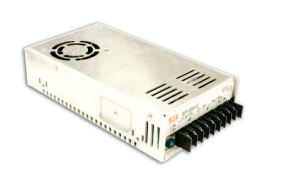
Power supplies are the beating heart of an outdoor LED system. I wrote a brief article on this topic previously  covering some scenarios on off-the-shelf product vs custom specified components. This article is specifically taking a look at the heart which pumps power through a system.

Power supplies primarily serve the purpose of AC to DC conversion and power flow control. In a PC, the power supply runs proper levels of power to different components in the system. In an LED system, the power supply takes 120V (or 240V) AC service and converts it to DC for the control components and LEDs to use. As little as 8 years ago, power supplies were built with this primary purpose in mind and had little-to-no safeties built into the system.

Current (quality) power supplies have several control factors and you should know what they are and how they work. If the manufacturer you're working with can't say their power supplies handle ALL of the features mentioned, you should be concerned as these are standard feature sets. Make them prove it...

Here are the standard features and what they mean:


SMPS Universal AC input / Full range
In a SMPS (switched-mode power supply) AC input is directly rectified and filtered to obtain DC voltage. Switched-mode power supplies are regulated to keep the output voltage constant. These employ a controller which monitors current drawn by the load. As power output requirement increases, the duty cycle increases thus ensuring the system has the power it requires.

Built-in active PFC function
Power Factor Correction (PFC). This is a somewhat complex system which could take pages to explain. Simply put active power factor correction consists of a number of capacitors which are switched by means of contactors. These contactors are controlled by a regulator that measures power factor in an electrical network. Depending on the load and power factor of the network, the power factor controller will switch the necessary blocks of capacitors in steps to make sure the power factor stays above a selected value. This keeps everything in the system even and regulates the power going through to the system, alleviating spikes/drops in power which could shorten the lifespan of your display.

Protections against Short circuit / Overload / Over voltage / Over temperature
Quality Power supplies often include safety features such as current limiting which protect the device from harm. In the event an abnormal high-current power draw is detected, the power supply recognizes this as a direct short and will shut itself down before damage is done. The same goes for excessive heat levels (which directly affect performance).

Forced air cooling by built-in DC Fan
Many power supplies are built with passive thermal management (perforated aluminum casing). Unfortunately this only serves low-end power systems. An LED display often requires significant power and can create high levels of heat (BTUs - British Thermal Units) which need to be mitigated within the system. 

Built-in fan speed control
Simply having a forced air cooling system isn't enough. The fans need to be managed with controls set to run at varying required speeds (from ) - 100%) when thermal sensors detect levels above a given threshold.  This ensures the system continues to operate optimally. As heat increases, a power supplies efficiency decreases and its output drops. Keeping the power supplies cool is incredibly important to ensuring the system performs at its best.

Fixed switching frequency at 100KHz
Resulting DC voltage is switched on and off at a high frequency by electronic switching circuitry.This produces an AC current which passes through a transformer or inductor. High frequency switching enables the use of  filter capacitors that are much smaller, lighter, and less expensive than pass-through systems (systems which use control chips to filter/convert power). After the inductor , the high frequency AC is rectified and filtered to produce the DC output voltage. If the SMPS uses an adequately insulated high-frequency transformer, the output will be electrically isolated from the mains; this feature is often essential for safety.

While this is a little drier than the regular articles posted, it's important to understand the heart of LED Display systems. A lot of manufacturers cut corners with the power supplies and they're hoping buyers won't know the difference. These seem like small, unimportant things (a power supply is a power supply, right?) but they have significant importance to the overall  lifetime optimal performance of your display. The more you know, the better you can source the best solution for your company and clients.

*I invite you to comment here and/or email me directly with requests at deacon@vantageled.com. Vantage LED has white paper resources and more educational material on the website (http://www.vantageled.com), please check it out when you have a moment. Note all posts/thoughts/writings are strictly the viewpoint of me and me alone and do not reflect nor speak for Vantage LED’s beliefs, attitudes, thoughts, etc. unless specifically stated.

Thursday, January 10, 2013

Digital Signage Sales 101: Sticker Shock Syndrome; dealing with cost objections

-Deacon Wardlow

     The discussion went well. The client's needs were discussed, a proposal was put together outlining the value of the solution, discussing how the solution fit the customer's needs and the various options available. When you get to the cost, you get "the face." Maybe not, maybe you get objections or surprise or (the worst) complete and utter silence.

When a customer gives you the same look as the baby in the picture to your left, things are not going well. Overcoming sticker-shock is an issue in any industry. I feel somewhat safe in saying we've all likely been there at one time or another. Today's blog, some ideas on overcoming (and completely avoiding) Sticker Shock Syndrome.

1. Budget
     Discussing budget is separate from price. If you were selling real estate, you'd want to know what price range the buyer is looking at so you don't waste their time (and they don't spend yours) on options they won't really consider. You could work with ranges. Are they looking for something which falls between $30,000 - $50,000? $35,000-$20,000? $20,000-$10,000? Don't dig for specifics, but if you have a range, this gives you something to work with. At least that's what many believe.

What you've just done though is start the wheels in motion and potentially built up concern and stress on the buyer's end. You just gave them a bunch of numbers which (to many) are rather expensive and there's no justification for the cost, no value. Just a bunch of high numbers. Many salespeople skip over a budget consideration and discuss the solution itself (which I recommend wholeheartedly). With Digital Signage (specifically LED Signs) you'll get an idea of what the client is looking for; then it's a matter of giving a few pricing options (good, better, best) and building the value of the proposal.

2. Build Value
     How was the proposal submitted? Did you hand the customer a folder with some system information, a job print and the price? Did you give them a single piece of paper with the cost in the corner? Did you shake their hand, look them in the eye, and say, "$$$$$$$$$$$$! Will get you what you need."? Don't give them a map and tell them where you want them to go, walk them through the proposal so everyone arrives at the same time.

I like folders (though there are several options which achieve the same end). Get as many folders as there will be people in the meeting and one "extra" for yourself or a surprise added member to the meeting (ideally something branded with your company logo/contact info). Hold on to anything you're going to hand out.

Part 1: Your company and why XYZ Company is the best for this solution (1 page, images of similar installations/work on that page).
Part 2: Why the solution is a great fit for their business (case study/best-use example, etc.) 1 page.
Part 3: The solution. 1 page for the hardware, 1 page for the software. Keep it short. Keep it simple.
Part 4: The implementation. 1 page, how long will everything take from order to installation and when can they use the system.
Part 5: What they're getting, a breakdown of costs associated and the final price.

Hand them each part as you discuss it. This helps keep everyone on the same page and paying attention to your presentation. Build the value in the system and how the solution will help them achieve their objectives (demonstrate how this will be a return on the investment vs. a purchase, discuss how the DS solution can achieve better outreach to customers and the community). By the time you reach the actual cost, there should be inherent value built into the pricing. The customer will see how the system either uses expenses (advertising money allotted from alternatives which aren't working well) or how it generates enough traffic to support the price (increased revenue or better outreach outweighs the initial investment in the system).

Overall, the best way to overcome Sticker Shock Syndrome is to avoid it completely by being pro-active. If there's true value in the solution you're providing the customer and you've outlined how they'll benefit, the initial cost is justified and then it's a question of not if, but when they'll move forward.

*I invite you to comment here and/or email me directly with requests at deacon@vantageled.com. Vantage LED has white paper resources and more educational material on the website (http://www.vantageled.com), please check it out when you have a moment. Note all posts/thoughts/writings are strictly the viewpoint of me and me alone and do not reflect nor speak for Vantage LED’s beliefs, attitudes, thoughts, etc. unless specifically stated.

Tuesday, January 8, 2013

Why LED Signs: Outdoor Digital Signage Helps Focus and Sustain Advertising to Potential Patrons

-Scott Hofheins

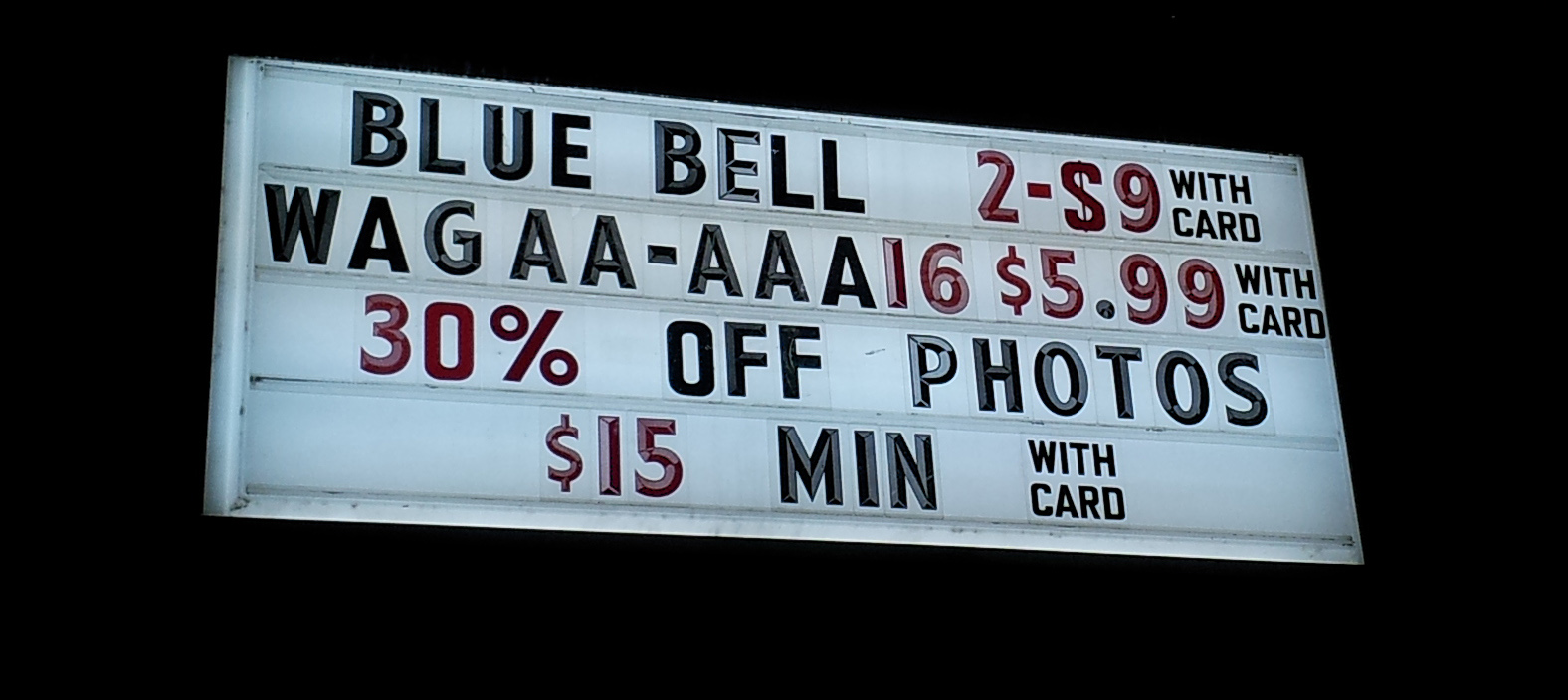
Happy New Year everyone! I hope the holidays were good and you have committed to some new years resolutions. Hopefully one of those is to get an LED sign for your business or organization, possibly to replace a “Changeable Copy” sign like the one below.


What is the second line on this sign trying to sell? Is it a prank or a missing letter? Is it some sort of hyphenated acronym? If it takes you longer than 1-2 seconds to figure it out, you are not alone. I had to drive by it twice before I knew what it meant. If you are still having trouble, the answer is at the bottom of this post.

By the time a motorist deciphers the coded message (if he even decides to take the time to think about it) he will be too far past the property to make the “convenient” stop. You do not want your advertising to be coded, especially on an outdoor sign where the audience has a limited time to read, process, and decide if they want to act now, keep the memory for later, or forget about it. I thought this would be a great picture for a future blog post about why LED signs are such a good investment, so I decided to stop, not to buy anything, but to take a picture.

A decision to purchase an LED sign is not a light one. They can be expensive, and the market is full of confusing information and less than straightforward sales strategies. The purpose of this blog is to help clear the way to the truth. There have been some great posts in the past on buying an LED sign, Deacon’s last post should be extremely useful for researching our blog.

LED Signs help focus your advertising and make the messages clear and dynamic so the motorist can make that decision quickly, and hopefully in favor of visiting your establishment.

No More
Acronyms

Your sign shouldn't look like a classified ad with abbreviations and acronyms that help fit the text on the sign by sacrificing readability. LED signs let you scroll, or use different size text to create a crystal clear and meaningful message your potential patrons.

Easy Message Creation

More than once, I've seen the previously pictured sign stuck on the ground for quite some time with half a message. This can happen for many reasons. They ran out of letters, the manager was called back into the store, or the motor got stuck. In any case, anyone who has placed letters on these signs can tell you its not a fun or creative experience. However, with an LED sign you have the convenience of creating messages at your own pace, in the comfort of your office using a full pallet of colors, backgrounds, and fonts.

LED Signs Look Better

You only get 1-2 colors to work with when you use a changeable copy sign. They do not age gracefully. The tracking breaks, causing the letters to hang crooked and they can get corroded and rusted. The lighted plastic face can become discolored or cracked. I couldn't get a good picture, but the other side of this sign was not pretty. It faces a less busy street, so I’m assuming they decided not to worry about and turned it off. However, LED technology has been getting better and you can expect a longer life, and a more graceful aging process with a high quality LED sign. Unfortunately there are still some signs out there using cheap components that give the rest a bad rap, but that's what this blog is for. We want to make sure you get the highest quality LED sign for your business. that will look good for years on end.

A Good Investment

When you have a quality sign with quality content, LED signs will pay for themselves. A measurable and significant ROI on an LED sign investment is virtually guaranteed, unless you're installing a sign in Antarctica advertising refrigerators. The key is to use an LED sign that is manufactured with quality components, has a good documentation and a solid support team. The only people I've talked too who regret there LED purchase, are the ones who used sub-par suppliers with outsourced support.

Effective advertising has a focused, dynamic and clear message to the target audience. Unless they are cryptographers, the message should be in readable, easy to understand words. Outdoor LED signs are the most effective way to do this and promote your business to local traffic. Prices have gone down, the displays are sharper, and the lifespan is continually improving. Make this year the time to take the jump and invest in a quality LED sign. If you don’t do it, your competition will.


-SH

P.S. The sign at the beginning of this post is advertising ice cream on the first line, and store brand (WAG) AA and AAA batteries in a 16 pack on the second line. 


I hope this post has been informative and helpful. As usual, I welcome ALL constructive comments. Please feel free to comment and add anything I’ve missed, or additional tips you may have regarding this topic. Please visit www.vantageled.com for many other resources, white papers, and of course: Great looking LED Signs!

**All posts/thoughts/writings are strictly the viewpoint of me and me alone and do not reflect nor speak for Vantage LED’s beliefs, attitudes, thoughts, etc. unless specifically stated.

Tuesday, December 18, 2012

Selling Value with Digital Signage Solutions: A simple equation = more sales


-Deacon Wardlow
 Nobody likes feeling helpless and (worse) being forced to admit to ignorance. When a client reaches out for help, they're expecting someone to bring them the solution and to make it clear and easy-to-understand why the solution presented is the best option available. As the knowledgeable "expert" it's up to you to make the value proposition to the client so the investment with Digital Signage is easy to make. The client's demonstrated a need by coming to you, it's up to you to demonstrate how that need can be met with the best overall Digital Signage (DS) package.

Simple calculation for the Value Proposition: V=BR (Value = Benefit and Return (either on Investment or Objective)

How do you achieve this Value Proposition? Let's take the example of an outdoor LED Display (as this is my particular area of focus):

Benefit:
Build a case for the display by first demonstrating your efficiencies -Why is your company the best to handle this request?
-What is your history and experience providing these solutions?
-How will it be executed/installed? (Having the client visualize the DS solution in place and working gets you closer to "yes.")

You should then move to your manufacturing partner (usually you're coming to the table with one or more partners). Your manufacturing/other partners should be able to provide cut-sheets on the product, information demonstrating why this solution is beneficial for the client's market segment, etc. If the partner can't (or even worse, won't) provide this information, it may be time to look for a new partner.

Return:
The typical "dollar shift" is a tried/true means of showing how the client can move money they spend on radio/print/other advertising over to their on-premise solution for a greater return on visibility and reaching their larger potential client base. The more people see the messages, the greater the return on their investment in the DS system and return on objective i.e. community outreach, increased presence in the market, interest in their business and product/services, all of which usually equates to a return on the initial investment with a typical 10%-15% growth in earnings.

Build the value by showing the Benefit of working with you/your partner(s) and the Return they stand to gain with the solution in place BEFORE giving them the final price for the solution. This helps build the reality of the proposed system and overcome the "sticker shock" syndrome of many clients. Selling on price is a reality we all have to face from time-to-time, but if there's no value you're just selling a number which anyone down the road can beat. Make sure you leave your best proposal with the client and you'll find you win more deals, more frequently (often when you weren't the lowest price). If there's value in what you're proposing, clients will pay for it.

There'll be no new posts next week and we'll start back up again in the new year. Thank you for your readership, your comments (online and off), your feedback and your desire to learn more. I hope we've been helpful this year. Happy holidays, I hope this past year has been good to you and yours and the next year is even better.

*I invite you to comment here and/or email me directly with requests at deacon@vantageled.com. Vantage LED has white paper resources and more educational material on the website (http://www.vantageled.com), please check it out when you have a moment. Note all posts/thoughts/writings are strictly the viewpoint of me and me alone and do not reflect nor speak for Vantage LED’s beliefs, attitudes, thoughts, etc. unless specifically stated.

Thursday, October 18, 2012

Short Term Gain - Long Term Cost: The Direct and Indirect Costs and Effects of Poor Quality LED Signs on Business

When an organization is looking for a new LED sign many of the same common factors apply as any major purchase, like a car or the latest HD television. What is the best product? What is the best value for the money? Who is the best manufacturer? Who has the best support? For items such as cars and televisions, consumer reports, websites and reviews are abundantly available to assist the buyer. Unfortunately, these types of resources are not as common in the LED sign industry and the buyer is sometimes left to decide based on limited information and eager salesmen.

Many are convinced to buy a cheaper, inferior product with the promise that they are “buying direct” or “getting the same sign, for ½ the cost”.  Some are even convinced that it’s worth buying a cheaper product, because the price is so good that they can just buy another one if it fails in 2 years. Unfortunately many have learned the hard way that there is no such thing as an “LED-Mart” where you can get cheap prices and reasonable quality product.

Poor quality LED signs do not just stop working after 1-2 years of operation. They break down continually as a function of their poor design and materials. This costs you time, money, reputation (see Deacon's Post) and a constant worry about the street image of your business or organization. Lets look at some of the actual costs for a poorly manufactured LED Sign.

Service Costs:

Signs are not like smart phones or cars. You can’t bring them into the shop, or ship them back to the manufacturer for repair. These are permanent fixtures on your property, and they are usually high off the ground requiring a bucket truck for access.

Some of the average rates for service are:

  • Standard bucket truck w/ technician: $150 per hour, 2 hr min.
  • Extended bucket or crane w/ technician: $250 per hour. 2 hr min.
  • A typical service call to troubleshoot a sign will take 2-3 hours: $450 - $750
  • A second trip to install parts usually takes 1-2 hours: $300 - $500

So you are potentially spending: $750 - $1250 per incident. If you’re servicing a sign just 5 times a year you looking at a yearly cost of $3750 - $6250, this adds up to $18,750 - $31,250 over five years. Rates and repair times do vary, but even conservative estimates add up over time.

But what about manufacturers that offer a labor warranty to cover these costs? The effectiveness of a labor warranty is highly dependent on the company that issues it. If they go out of business or are slow to respond to issues, you're stuck with a disabled sign and sometimes have to cover the costs anyway. A good labor warranty should be insured by a third party and the manufacture that issues it must be financially strong and in it for the long term.

Indirect Costs:

Your time is money. Time spent coordinating service calls, troubleshooting the sign, and navigating through poorly designed software costs you money in the long run. It’s hard to quantify the actual dollars lost, but the fact stands that a small business owner who is spending time fixing a sign, is not spending time making money for the business.

Visual appeal is important for any organization or business. When you buy an LED sign you are investing in it’s ability to do one major job: Advertise. When your sign is constantly broken it is not doing it job, and you are losing the return on your investment. To the public, the quality of a sign will reflect the quality of the organization it promotes. A broken sign will cost you business in the long run.

The initial gain from a low cost product is quickly overcome by the cost and negative effect it has on your organization. This is not to say that a higher quality or more expensive sign will never have issues, but the frequency and fix-ability of these issues will be significantly different.  A high quality sign will stay fixed because the design is sound, and the manufacturer cares about the long term operation of the product. When looking for a good LED sign supplier, don’t trade short term value for long term headaches.

- Scott Hofheins

* I welcome ALL constructive comments. Please feel free to comment and add anything I’ve missed, or additional tips you may have regarding this topic. Please visit www.vantageled.com for many other resources, white papers, and of course: Great looking LED Signs.

**All posts/thoughts/writings are strictly the viewpoint of me and me alone and do not reflect nor speak for Vantage LED’s beliefs, attitudes, thoughts, etc. unless specifically stated.