Showing posts with label Wireless. Show all posts

Wednesday, March 12, 2014

Digital Signage Need To Know: LED Display Evolution


There is little doubt that the modern outdoor LED display is a cost-effective advertising machine. 

With a very low cost-per-exposure for your advertising message, and 24/7/365 functioning there’s no worry about this employee updating their Facebook page instead of doing the job assigned. 

Not only cost-effective, it is also willing to do what you tell it, when you tell it, and for as long as you’d like. If you want a new slide to advertise your Easter Egg hunt at the church, type your slide description request in and soon the glitzy piece of artwork has automatically been produced by a professional designer and downloaded into the LED display's ad rotation. Not every LED display can do this function, so do your homework and determine what your business needs and where to find these professionally produced slides.

LED displays are becoming smarter and the mystery of the control software is dissolving as leading manufacturers build user-friendly platforms and interfaces. Perhaps someday, you may even go to your local Sam’s or Costco and buy a “plug and play” LED display not unlike a 60” Samsung TV. There are market forces commoditizing everything!

Ah yes, we live in a marvelous age of advanced technology being focused on outdoor signs. But it hasn’t always been that way. How and from where did today’s signs come to be?

There may have been some industrious cave dwellers scratching images into cave walls, to document and tell stories but these efforts are not generally considered to be the first signs. Most historians date the beginning of signs well past Fred Flintstone and Barney Rubble into the Greek and Roman era.

Stone and terra-cotta symbols and drawings were used since most of the world was illiterate. Perhaps these early sign builders were visionary as LED displays today seem to “say it” more in pictures than in words. Pictures capture the imagination and communicate ideas as well, if not better than, text- words. A symbol for a tavern, for example, communicated the idea to all.


Here is an example of what appears to be a tile sign, early Roman- a warning that the owner of the home had guard dogs. It is simple and effective.

Religious groups used the symbol of the cross, and tradesmen used their sign symbols to advertise their specialty.

As time marched on the use of symbol signs became law. In the late 1300’s a law was passed that any tavern selling ale “must” have a symbol sign. Meanwhile those “trade signs” became more ornate and unique and featured logos of dragons and lions as business identities were established.

With the onset of the 19th century (1800s) the world’s advancing technology began to shape the sign industry. The invention of the printing press established the course centuries earlier but the advent of the industrial printing press, the innovations that expanded the print area and drove the printed output to thousands of pages per hour. This was a step towards the modern sign industry of today.

The excitement of the modern sign industry did not begin until the widespread use of electricity became common place. The incandescent bulb was the backbone of the new trendy signs and designers made the best use of them.

Neon signs followed the incandescent bulb era (1910- Paris Motor Show) and glass blowers and artists began to produce not only messages but works of art. But a neon sign is unchangeable and permanent. 

In the mid to late 40s, technology again changed the sign industry with the introduction of plastics which included the changeable letter signs. Flexibility and messaging was improving.

In 1962 Nick Holonvack, Jr. of GE, developed the first red LED lamp that produced light in the visible spectrum and the race towards todays LED sign industry began.

The LED displays we see today evolved from simpler designs of the 1990s.The early LED sign industry began to gain prominence and traction in large-scale sporting venues and other commercial applications. Las Vegas and Times Square became the glowing beacons for what technology could develop.

Today, as software evolves, animation, live video and other “mind-blowing” graphics have transformed both the digital billboard industry and the on-premises signs (smaller than the billboards and owned by the resident business).

The sign industry of today produces about $50 billion dollars a year in sales. Digital signs have driven much of the excitement and the sales within the sign industry and it’s only expected to get better. 

One could say… our future's so bright… we gotta wear shades! I'm sorry, I couldn't resist!

These comments are my personal perspective and do not reflect the opinion of Vantage LED, Inc. or SignVine, Inc. or any other person or organization. If you have constructive feedback please email me at                                                          michael@signvine.org.
                                               
                                                    -- Mike Prongue


Tuesday, May 14, 2013

Digital Signage, Need to Know: Value Based Selling Is a Win for Local Sign Companies


What we obtain too cheap, we esteem too lightly; it is dearness only that 
gives everything its value.      – Thomas Paine


In the “bad old days” of the mid 1980’s an early dent was made in my car stereo business by the giant retailer Wal Mart. They sold Jensen and Pioneer and all the brand names that we sold and we swore we could never win against them. I saw my brother gesticulating wildly across the installation bay screaming “Run Chicken Little we are doomed- the sky is falling!”

The sky did not fall because almost no one buys on price alone. Most customers wanted installation and technology and Wal Mart could not deliver! New product reached Wal Mart about 2 years after it was introduced by the manufacturers, so while we received the new high performance gear and the "411" in about 30 days, so they never had a clue. The staff at Wal Mart was replaced so often that the car stereo department became totally self-service to the customer.

We used a three step program to ameliorate the price impact of the National Giant.

1)      Communicate, educate and partner with your customer.
2)      Demonstrate a huge service and technical advantage.
3)      Never say “no” to your customer.

You have to walk the talk to compete and if you need to become an expert, like your business card claims, well… today is the first day of the rest of your life. And tomorrow is the second!

Today, 2013, many local LED sign companies fear the National LED Sign Companies operating in their market. There are several and I won’t call them out by name, but you know who they are. 

Some blow into town and make a quick sale and promise a $200 install of the LED sign by the business owner’s electrician, only to disappear into the proverbial woodwork once the deposit is collected. Then like rising smoke- gone for good. Others operate with good product, a project management team and competitive price. But they too have many disadvantages, as compared to the local professional.

If the customer can see you “eyeball to eyeball” and shake your hand and go fishing with you (metaphorically speaking), why would they care about National LED Sign Company #1 or National LED Sign Company #2? The sign industry is really not an e-based phenom, or a "dialing for dollars" experience as many National LED Sign Companies try to make it out to be.

Customers want to know you, see the product, and discuss their requirements. They also want continuity where the person writing the sales order either is, or personally knows, the person installing and servicing the LED sign. These are all extra "values" that a local sign company can provide.

Value-based competition is the way successful local LED sign companies operate. When value improves, the end-user customer and the sign company benefit. The local LED sign companies that find creative, reassuring and unique ways to deliver superior value win. The local LED sign company is then rewarded with more business from the same customer and their referrals. Customers win too, as they receive an LED sign that continues to operate with near-zero down time.

Here’s what you must do to win against the National LED Sign Company:

1)   Carve out an uniqueness. What is your niche? Do you specialize in attorneys, schools, churches? Client uniqueness is just one way to separate your company from the rest of the pack. You need a unique selling/marketing point. I can’t make one up for you, but you probably already have one, even if you've never called it by name.

2)   Create an identity that warms you up to the customer and truly represents the service level you plan to deliver. GM had “Mr. Good Wrench” several years ago. What is your "street name"?

3)   Become a technical guru. At first, there seems to be an endless amount of technology to learn when dealing with LED signs. False! Most of the technology has nothing to do with LED sign itself. Simplistically stated, they are an aluminum box with "flashy lights". The technology requirement comes from the wireless communication, the computer controller and the network it’s installed on. You need to have someone who is more than comfortable here- someone who likes it! The guy running the printer in the back room may not be your LED guru. Also use a manufacturer who can support you with more than excuses and platitudes.

4)   Service, service, service and service with urgency. This means you must be empathetic to the customer, but more importantly- don’t sell junk or your life will be pure misery keeping up with service calls and trying to explain to new customers why their LED sign will work when many of the others don't.

5)   Don’t sell junk. Nothing destroys your credibility more than a city full of LED signs that work ½ the time. If you sell an unreliable product and make a small profit, your profit will be spent many times over on service calls.

In short, by doing some variant of 1-5 above, you are engaging in value-based competition. Add to that the personal attention you provide and the assurance that your customer will see you in church or “on the lake” and competing with National LED Sign Companies will be a non-issue.

If you are selling on price alone, you are in a death spiral. Look at the instruments and try to pull out while you can. No one wins in a price war. Again, as I've preached across many blogs- "There ain't no such thing as a free lunch" and every customer ultimately gets exactly "what they pay for"!

Reality-101 says you won’t win every bid. If an organization does not seek quality, is willing to install an imported LED sign that will look terrible from day 1, does not want your sage advice and thinks LED signs are like turnips- all the same… run. There are toxic deals where you are more profitable if you lose. I question whether or not any National LED Sign Company can truly sell a similar product cheaper. Do they or when the the extra costs for permitting, installation, electrical are added to the core price they lose their edge? Focus on what you do. Know what "they" do, but don't be intimidated. Many times a detailed explanation that LED signs are not turnips is all it takes to shake off a National LED Sign Company from your customer's door.

If you look at the enormous market that is the USA, there is no way any “National” LED Sign Company can do much in your town to take your business unless you let them. 

Not unlike David, the the biblical David (of Goliath fame), everyone reading this has “Giant Killer” juice coursing through their veins. Those alleged “Big Boys” are trying to be like you but they can't get it right and they don't know your customer. They are the ones who should be afraid- very afraid, of you!

These comments belong to me, Mike Prongue, and do not reflect the views, opinions, hopes or dreams of anyone else, anywhere else and this includes Vantage LED. I appreciate your constructive opinion which may be sent to me at michael@vantageled.com.  

Tuesday, January 29, 2013

Digital Signage "How To": Securing Wireless ( WiFi ) Communications for LED Signs


- Scott Hofheins


An increasing number of  businesses, organizations, and public entities are seeing the value in LED and Digital Signage. The number of LED Signs on the streets has increased quite a bit over the last 10 years. With this growth, comes a greater need for manufacturers, dealers, and end users to make sure these signs are secure from outside parties who would use the sign in a manner not consistent with the owners intentions or local laws.

An overview of many of the communications options available can be found in my previous post. However, I would like to focus on Wireless communication because it is the most common option currently in use. I have purposely written this post using general terms to avoid anyone using it as guide on how to cause trouble.

There are three basic concepts to remember: Wireless Security, Software Security, Network Security.

Wireless Basics
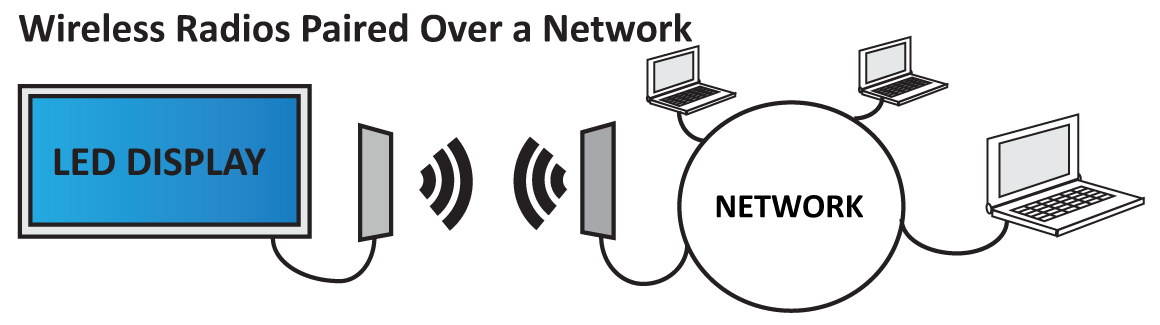
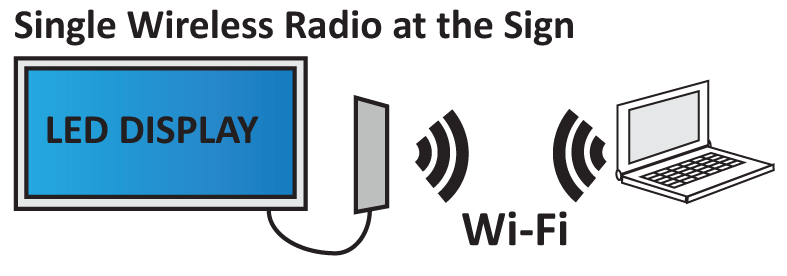
Most signs are supplied with 2 wireless devices. One unit connects and resides at the sign, the other at the building connected to the users network or computer directly. (In some applications, only one radio is used)


These radios communicate to each other and create a “wireless cable” from the building to the sign, allowing end users to manage their sign without having to run an actual cable out to the sign. These radios can use a variety of frequencies and security methods to connect the sign to the end user.

Frequencies
  • 900 MHz: This has been used for many years in wireless communications between devices. Many traffic devices and networks use this frequency because of its range. However, it has a much smaller bandwidth capacity than the other options so most new LED signs do not use this anymore.
  • 2.4 GHz: This is the most common wireless frequency in use today. Most home networks use this frequency for their “WiFi” connections. Most laptops have a 2.4 Ghz WiFi card built in.
  • 5 GHz: This is gaining popularity, but is still much less common than 2.4 Ghz. This uses some of the same “WiFi” standards as 2.4 Ghz, but is inherently more secure because it is less common. In my opinion, this is the best frequency to use because it mixes the speed of 2.4 Ghz with the security of 900 Mhz.
Wireless Security
WiFi security has greatly improved over the years. Encryption and password based security is much better and easier to set up than ever before...but only if you actually use it. Here are some things to remember:

  • Factory Settings: A good manufacturer will change the factory settings on the wireless devices to it’s own secure settings. These should not be published in any public documentation, but only available to the end user and/or sign dealer supporting the signs. Part of the reason we saw those “Zombies Ahead” signs a couple of years ago was due to unchanged factory settings (See Deacons Post). As an extra precaution you can always set your own security settings for the radios, but remember to document these changes. You could get in a bad situation if your computer crashes and you have to re-enter the settings.
  • Quality Devices: Make sure your manufacturer uses established, well tested wireless products. You do not want your sign using a sub-par device with weak encryption and security options.

Software Security
A well designed LED sign system will also incorporate direct and indirect software security as an additional firewall to intruders.
  • Not Publicly Available: Avoid software that is available for public download. The only people who should have access to the sign software is the dealers and the end-users.
  • Secured Installations: Installations should be secured with an “Activation Code” or other security system to prohibit unauthorized parties from installing copies of the software. Avoid unsecured or generic software.
  • Cloud Based Options: This is a new concept in the LED Sign market, but there are options currently available. Internet based sign management can be another way to secure all your content because you can rely on enterprise level security and off-site hosting. This makes it much harder for anyone to do any real damage to the sign with local access.
Network Security
This is another key point to ensure protection. Your network should be reasonably secure and access restricted to your own personnel only.  
  • Secure your Computers: All of your computers should be password secured. Most windows based systems allow you to require a password to log into the system after the computer goes into the “Screen Saver” or “Sleep” mode.
  • Physical Access: Make sure you install the sign software only on the computers you have direct control over, and who’s users you trust. An extra security measure can be to have a dedicated laptop that is on it’s own network, connected directly to the sign using the wireless radios.
Wireless security is important for LED signs. Make sure your manufacturer is using quality hardware and unique wireless settings to avoid a “Zombie Warning” situation. Your own network should be secured with common sense security practices like passwords and restricted access. Your manufacturer or dealer should be well versed enough in the unique security needs for LED signs to help guide you in the best options for your specific installation. An LED sign is a large investment, make sure the security, options, and hardware quality reflect this.

-SH


I hope this post has been informative and helpful. As usual, I welcome ALL constructive comments. Please feel free to comment and add anything I’ve missed, or additional tips you may have regarding this topic. Please visit www.vantageled.com for many other resources, white papers, and of course: Great looking LED Signs!

**All posts/thoughts/writings are strictly the viewpoint of me and me alone and do not reflect nor speak for Vantage LED’s beliefs, attitudes, thoughts, etc. unless specifically stated.

Thursday, September 27, 2012

Communication Methods for LED Signs / Electronic Message Centers: Wireless, Hard Wired, or Both?


LED Signs communicate information to the public, but how do you decide the best way to communicate to the sign? There are many ways to do this and each option has its own pros and cons, depending on your specific installation type.

There are (3) types of approaches to communication: wired, wireless, or both. Some locations have existing hard wiring to the sign site, others are more remote and using a cellular modem is the only realistic option.


WIRED (HARD LINE)   
  
In the past, before high speed networks were common, LED signs were usually hardwired using a phone modem or serial cable (RS485 or RS232). These options were fine back then, because the signs were less sophisticated and the actual data sent to the sign was minimal. As LED sign technology expanded, larger file sizes were required. These options became less common and were replaced by standard Ethernet network cable or Fiber Optics. The older options are still used in special situations like factory production floors where they have a large serial network with simple machine code, but for the commercial market Ethernet and Fiber have become the standard wired solution.


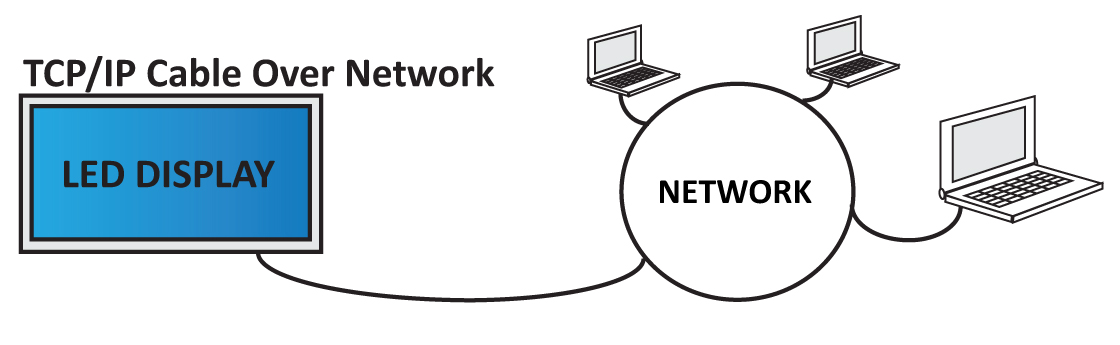
Ethernet TCP/IP  (Cat5/6 Cable - RJ45 Ends)

 
This is a common option for wall mounted signs, or street signs that are closer to the building or network drop, where the cable run is less than 300 Ft. Most LED sign manufacturers offer this connectivity imbedded into their system without any special adapters. Signs that require separate “Ethernet Adapters” may be using older Serial based controllers.

  • Maximum run is 300ft without a network switch in the middle to boost the signal.
  • Less fragile than Fiber Optics. Harder to damage.
  • Ethernet networks are very common, and the cable is inexpensive.


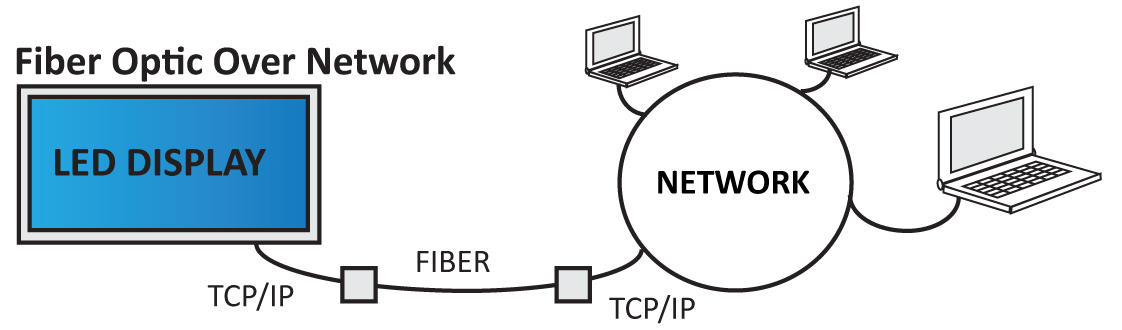
Fiber Optic Cable

 
Although somewhat rare in commercial LED sign installation, Fiber is still commonly used in the military. Data is sent using light signals across refined glass strands that make up the fiber optic cable. An “Fiber Optic to Ethernet” converter is usually required on both sides of the system: one placed at the sign, and the other at the building where it connects to the main Ethernet network.

  • Long distance capability near 40 miles with Single-Mode (more expensive), and 10 miles using Multi-Mode (less expensive).
  • Fragile, and can be expensive to run and repair if damaged.


WIRELESS
  
You can get Wireless Radios that connect to serial networks, cellular networks, and standard Ethernet TCP/IP networks. Many frequency standards can be used, but the most common ranges are 900 Mhz, 2.4 Ghz, 5 Ghz and Cellular. Wireless radios have become the standard option for most manufacturers because they allow for a broad range of installation types, and can save time and money by not having to run a hard line in the ground.

Wireless is best when you have an LED sign that will be within 100-200 yards of the transmission point with clear “Line of Site” (no buildings or metal walls between the radios). The most common configuration  is (1) wireless radio installed at the sign, and (1) at the building. You connect the building radio to your network, or computer directly and the radios function as a long wireless “cable” connecting you to the sign. Other configurations can be used depending on the installation like Point to Multipoint, WiFi Access Point, and others.  


Common Frequency Types:

900 Mhz (slower data rate, longer distance): These were much more common in the past, when serial networks abundant. However, there are products out there that will use a multi channel 900 Mhz signal with a standard ethernet network to boost the data rate. These radios are best used for installation with special needs like distance or if the signal needs to go through structures between the sign and the transmission point.

2.4 Ghz (standard WiFi frequency): These radios are the most common, and have a good balance of distance and data rate. 2.4 Ghz is the most used frequency in the USA for home and commercial WiFi networks. This poses a slightly larger security risk for your sign, if the radios are not secured properly. (Deacon’s post on LED sign security)

5 Ghz (higher data rate, more secure): This frequency is less common than 2.4 Ghz, making it a bit more secure because most hackers are not looking for signals in the 5 Ghz range. You also avoid possible interference from other 2.4 Ghz devices in the area. Many manufacturers are leaning toward this option as the default choice for LED signs.

Cellular Modem

Another wireless option is a Cellular Modem. These are gaining popularity, but are less commonly used for LED signs. They provide access to the sign over the same data network as your smart phone (3g, 4g, LTE, etc..). Without getting too technical, the system works like this:

After purchasing a “Data Only” monthly plan through a wireless carrier supported by the Cell Modem (ATT, Verizon, T-Mobile, Sprint),  the wireless provider will then provide an external internet IP address for the Cell Modem to use. The Cell Modem is installed and connected to the sign (likely using a secured router). You can then send messages to the sign over the internet by using the unique IP address previously provided.

This option is best used for signs that are controlled off-site, in remote locations, or outdoor digital billboards.


WIRELESS AND HARD LINE

I’ve been on installations who utilize both options as a fail-safe measure when the sign is providing mission critical data. This is more common in a military setting, but I’ve seen schools and other government organizations use this approach. For the average user, I believe it’s overkill, but if you do decide to take this route make sure you communicate this to the manufacturer. Some manufacturers will need to put an extra “Network Switch” inside the sign, and this can be an extra fail point. Others will have multiple network ports built into their sign control unit, a much better solution in my opinion.


Conclusion

The bottom line is, make sure you work with the manufacturer or LED sign dealer to get the best solution for your installation. Not being able to communicate with your brand new sign because the communication method is in-correct can really ruin the excitement of the moment. If your manufacturer doesn’t pre-program street ready messages on the sign, you may be stuck with “Sign Test 3” scrolling across the sign until the communication is fixed.

Make sure your manufacturer secures the wireless devices prior to shipment, and allows you to configure them with your own security measures if needed. Communication to your sign is a fundamental necessity, make sure you get the best solution and equipment from your manufacturer.


-Scott Hofheins


I hope this post has been informative and helpful. As usual, I welcome ALL constructive comments. Please feel free to comment and add anything I’ve missed, or additional tips you may have regarding this topic. Please visit www.vantageled.com for many other resources, white papers, and of course: Great looking LED Signs!

**All posts/thoughts/writings are strictly the viewpoint of me and me alone and do not reflect nor speak for Vantage LED’s beliefs, attitudes, thoughts, etc. unless specifically stated.