Tuesday, October 9, 2012
Quality Control for LED Sign Supply Chains
Anyone who has experienced the unique challenges of trying to source product or components overseas will tell you it is not for the weak spirited. Even Apple, one of the most successful companies in the world today is not immune to troubles with oversea suppliers (see here). The logistical, cultural, linguistic, and engineering aspects of sourcing products overseas do not always align correctly. Although It’s safe to say that virtually every LED sign manufacturer uses some components that are sourced from overseas manufactures in one way or another, not all of them have been able to control the quality of these components effectively. This post is written mainly for sign companies who are considering buying “direct” from overseas suppliers, but it will also be educational for end users who are in the market for an LED sign.
Quality control is hard to manage when you're working with factories that are 7000 miles away. It can be done, but it takes a balanced approach and a major commitment by the US based organization. When you buy from organizations that do this well, you significantly decrease your risk of getting a sub-par product and ultimately save time and money by avoiding lengthy service issues and sign outages. However, when you buy from an organization that does this poorly or manufactures most of their LED sign overseas, the risk of poor quality product increases greatly. Here are some reasons why:
Limited Oversight
US distributors or manufacturers who do not have direct contract with the supplier find themselves completely at the mercy of their quality control system...if one exists at all. It is crucial to have direct contact with the suppliers, the ability to meet face to face, speak the language, and to know the right people. There are a large number of overseas component suppliers, but a smaller number of good suppliers out there. Knowing the right supplier to use, and having a good relationship with them is key to a successful quality control program.
Component Swapping
This is something that continues to plague distributors of overseas products. Mike’s last blog post addressed some important aspects of this issue (see here). Many overseas manufacturers will build the sample product (and even the first production run) with high quality components. The initial product seems to work well, and the distributor puts more orders in. This is where many manufacturers will start to swap out the internal components with less expensive alternatives over time. This is done without notifying the US distributor and the end result is a sub-par product that may work initially, but fail miserably after only 1-2 years of service.
Inconsistent Product
Distributors that do not have the resources to design, engineer, and oversee production find out very quickly that their product will be changed to suite the needs of the overseas supplier, without consultation. Component locations, LED Binning (color grading), connector locations, and physical materials are common areas for unannounced changes.
Multiple Sources
When US manufacturers rely too heavily on a single source for a particular component, they lose the ability to respond to product shortages quickly and effectively. The ability to demand quality control is also diminished if the manufacturer doesn’t have an alternate supplier to go to if the quality suffers.
Over the past 5-6 years, sourcing overseas suppliers has expanded in a way not friendly to the sign distributor, or the end users themselves. Unfortunately many sign companies believed they had found a perfect solution to increase profit margins by “going direct” to an overseas manufacturer. However, they did not realize what it really takes to reliably source, produce, and bring components into the US while maintaining the quality expected by today's consumer.
In my opinion, the best manufacturers commit the resources and spend the money needed to support a solid high quality supply chain. They don’t source the entire production overseas, but only the components that make sense. They develop relationships with the best suppliers, and work with them directly. Controlling the quality of the supply chain is an important aspect of our industry and must be actively addressed by the manufacturer. Doing this effectively benefits everyone, including the end users who ultimately feel the effects of a good, or bad supply chain.
-Scott Hofheins
I hope this post has been informative and helpful. As usual, I welcome ALL constructive comments. Please feel free to comment and add anything I’ve missed, or additional tips you may have regarding this topic. Please visit www.vantageled.com for many other resources, white papers, and of course: Great looking LED Signs!
**All posts/thoughts/writings are strictly the viewpoint of me and me alone and do not reflect nor speak for Vantage LED’s beliefs, attitudes, thoughts, etc. unless specifically stated.
Thursday, October 4, 2012
EMC- Specification Switchout
- Mike Prongue
Your client, Daniel J. Smith, Esq., corporate lawyer for a Fortune 500 company has walked into your 11th Avenue exotic sports car showroom in Manhattan.
“Good morning Don,” Mr. Smith said, extending his hand for a firm shake, his diamond cufflinks showing from under the cuff of his Gieves & Hawkes custom-tailored $4,000 suit. Mr. Smith is 52 years-old and an exacting professional who does not always please easily
“Let me look at my new car,” he said with excitement.
“Well Mr. Smith, we are almost done with the final detailing and it should be ready within the hour, “ you say smiling, “I know you’ve waited three months for this car, and it was hand-assembled to your specification requests.”
“But…” you say, as the showroom clears out and a deathly silence descends.
“They changed the color from red to green, and the 6-speed transmission was replaced with an automatic.”
“No extra charge!” you add, failing in your desperate attempt at levity. You can see the legal papers already being filed at the courthouse.
Of course this type of last minute switch-out would create an issue of apocalyptic proportion and would never be tolerated by the car dealership or any customer.
In the Electronic Message Center (EMC) industry, this happens every day, much more so with imported projects. Manufacturers need not be named as it occurs across a broad spectrum of suppliers.
What does a Sign Company or EMC distributor do when this occurs? What leverage do they have? It seems like very little, actually.
The Sign Company or EMC distributor placed an order in good faith usually after receiving a deposit from the customer. They ordered the project from some supplier, sometimes off-shore, precisely communicating the exact specifications the customer requested, money is wired to begin the project and the final payment is wired before the project ships, usually about 6-weeks later.
The customer is waiting. The EMC comes in and it is the wrong pixel size, has rear opening cabinets instead of front removable modules, or the amber grayscale request has been changed out with a red screen.
Two and a half months have passed since the order was placed and the project is late, having been placed on an extended hold in US Customs at the Long Beach, CA port. Now it must be installed in only 7 days to support the grand opening of an auto parts store. The clock is ticking!
You can’t send it back to China (for example), as it would take at least 4 weeks to get there. What do you do? Make excuses or give the customer a discount? Not good enough to ensure a customer for a week much less a customer for life. There is no good strategy at this point.
You can call and complain and perhaps get a discount on the next order, but then somehow that order is also wrong and now you have two compromised customers and the dysfunction continues.
Project specifications for your order are not wishes- they are a precise requirement. When an order is placed however, it never seems to occur to the Sign Company or EMC distributor that such an egregious error could happen. The Sign Company may never know if the system was manufactured in “error” or if it was actually a pre-built project which had been canceled by some other customer ("close enough" to match the dealer's order). This is called a “switch out”. One never knows, does one?
It is important to know your supplier, have legal recourse, have timely production updates, and a signed sales order showing you exactly what to expect. Ordering an EMC is not game of roulette if you have done your homework by calling references and checking them out. As they say “You get what you inspect, rather than what you expect.”
So, it’s critical to choose wisely and do not become the victim of the “last minute switch out”. It does happen every day in the EMC industry.
Isolated production mistakes with U.S. manufacturers can be rapidly resolved because contract law is honored here and solutions can be shipped rapidly. Rectifying the much more common international situation, perhaps a last-minute “switch out”, is an entirely different problem and for which a good solution remains elusive.
**Note all posts/thoughts/writings are strictly the viewpoint of me and me alone and do not reflect nor speak for Vantage LED’s beliefs, attitudes, thoughts, etc. unless specifically stated.
Labels:
Digital Display,
Digital Signage,
Electronic,
Electronic Message Center,
EMC,
EMC Message Center,
LED Sign,
LED System,
manufacturer,
Sign
Tuesday, October 2, 2012
LED Sign 101: Hidden Costs /Issues/What to look for to Identify Quality vs Cheap Components
-Deacon Wardlow
Technology can get very complicated. Once upon a time, it was enough to ask what LED a manufacturer was using for their LED Sign systems, the LED used would be a general qualifier to demonstrate if the manufacturer is using high-end components or cutting corners. With the release of patent-rights with LEDs and improvement of automated systems, this qualifier isn’t enough. It can feel like you need a Doctorate to wade through the technical terms. Have no fear, the “Geek Speak” team is here to help you through.
System specifications are a great place to start your qualification.
Colors:
Start with the number on Colors (you can find the original blog here). It used to be 16.7 Million colors was good, billions was better. Most control systems are now low enough (cost-wise) to allow manufacturers to go high-end without heavy costs required pushing the numbers up to Trillions. The higher the true color value available the better. Higher color values are an indication of higher overall depth of color and overall system performance. Lower values are an indicator the manufacturer is cutting a corner to achieve a lower cost (a few dollars here and there add up in the long run for a manufacturer, but the corner cut means a lower-performing system which will not be ideal for the long term investment being made).
Power Supplies:
I wrote a blog a few months back on this topic. Not only is the type of power supply critically important, but how the manufacturer is driving the power matters as well. Many manufacturers will drive power supplies at about 70-80%. This doesn’t sound bad to most people (they’re using less than 100% right? That’s gotta be good…). Unfortunately, the power supply performance is based on temperature. The hotter a power supply gets, the lower its performance capability. Optimally, a manufacturer should only be drawing upon 50%-60% or less of the power supply’s available power. This ensures the power supply will perform optimally regardless of high temperatures/environment. If a power supply is driven at 80%, the moment heat rises above 85 degrees, the system performance starts dropping. If the power supplies are driven at high values (70-80%) the moment performance drops below the 70/80% mark, the power supply will shut down and cause the system to go blank.
Conformal Coating:
Conformal Coating is incredibly important for the long-term optimal performance of an LED system. Further details are available in a prior blog written last month. When you look at the green PCB (Printed Circuit Board) on the back of an LED module, you’ll see a glossy shine. This should be even without clumps and dull/matte areas. Conformal coating protect sensitive components from oxidation, break-down, and damage from the environment. Poor conformal coating will cut the lifetime performance and expectation on a system down to a third or less.
FPS (Frames Per Second):
Another indicator to check the quality of the controller is refresh rate and FPS. Low values indicate a lower quality system. Baseline FPS should be 40-60 (not lower than 40) with a refresh rate of 1200+Hz). LED Signage is a big investment which will run returns over a decade. While cutting costs with a cheaper controller may appear good in the beginning, the overall performance takes a hit.
Hidden Costs:
Conformal coating on power supplies, adding a more robust capacitance to circuit boards, higher-grade chips, etc. are all small incidental costs which add up. Many manufacturers avoid higher-end components figuring the end-user won’t know any better and the performance is still “ok.” Not using proper conformal coating leads to shorter lifetime performance for system critical components which will require replacement.
While these seem like small things, the details are important. When looking at a low-cost alternative or dealing with a manufacturer who carries a second, “cost effective” line, make sure you get a full explanation of how that lower cost is achieved. The money the manufacturers saved by not using the best process or product ends-up costing the end-user with premature service calls (which can cost hundreds of dollars a visit) and it can cost the dealer their hard earned reputation as a reliable source for quality solutions. Cutting corners may appear to save some money up front, but will cost in the long term.
*I invite you to comment here and/or email me directly with requests at deacon@vantageled.com. Vantage LED has white paper resources and more educational material on the website (http://www.vantageled.com), please check it out when you have a moment. Note all posts/thoughts/writings are strictly the viewpoint of me and me alone and do not reflect nor speak for Vantage LED’s beliefs, attitudes, thoughts, etc. unless specifically stated.
Labels:
after-service,
cheap led sign,
coating,
comparison,
components,
Cost,
development,
Digital Signage,
Electronic Message Center,
EMC,
LED,
LED Sign,
manufacturer,
mark,
Regulation,
safety,
Vantage LED,
warranty
Thursday, September 27, 2012
Communication Methods for LED Signs / Electronic Message Centers: Wireless, Hard Wired, or Both?
LED Signs communicate information to the public, but how do you decide the best way to communicate to the sign? There are many ways to do this and each option has its own pros and cons, depending on your specific installation type.
There are (3) types of approaches to communication: wired, wireless, or both. Some locations have existing hard wiring to the sign site, others are more remote and using a cellular modem is the only realistic option.
WIRED (HARD LINE)
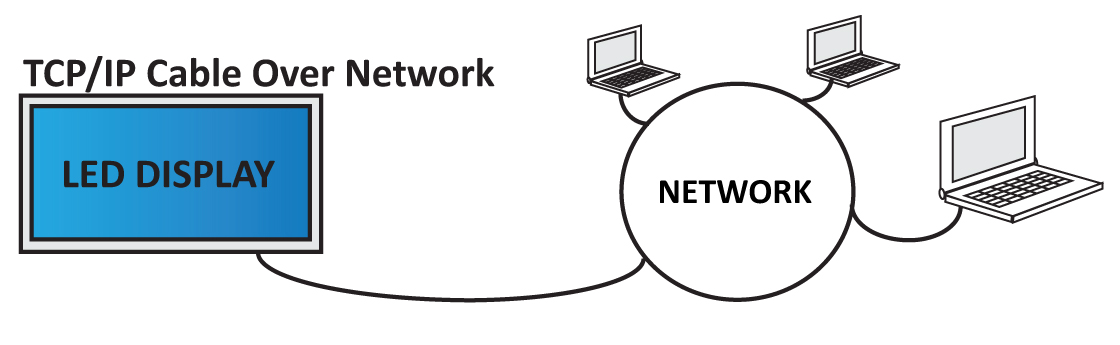
Ethernet TCP/IP (Cat5/6 Cable - RJ45 Ends)
This is a common option for wall mounted signs, or street signs that are closer to the building or network drop, where the cable run is less than 300 Ft. Most LED sign manufacturers offer this connectivity imbedded into their system without any special adapters. Signs that require separate “Ethernet Adapters” may be using older Serial based controllers.
- Maximum run is 300ft without a network switch in the middle to boost the signal.
- Less fragile than Fiber Optics. Harder to damage.
- Ethernet networks are very common, and the cable is inexpensive.
Fiber Optic Cable
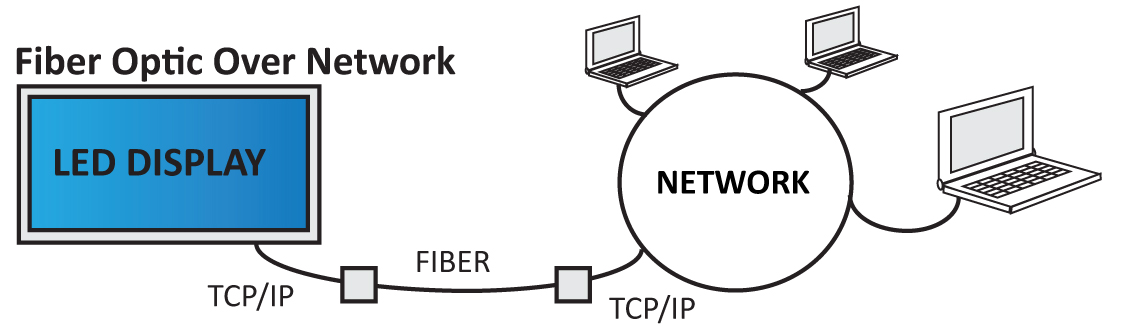
Although somewhat rare in commercial LED sign installation, Fiber is still commonly used in the military. Data is sent using light signals across refined glass strands that make up the fiber optic cable. An “Fiber Optic to Ethernet” converter is usually required on both sides of the system: one placed at the sign, and the other at the building where it connects to the main Ethernet network.
- Long distance capability near 40 miles with Single-Mode (more expensive), and 10 miles using Multi-Mode (less expensive).
- Fragile, and can be expensive to run and repair if damaged.
WIRELESS
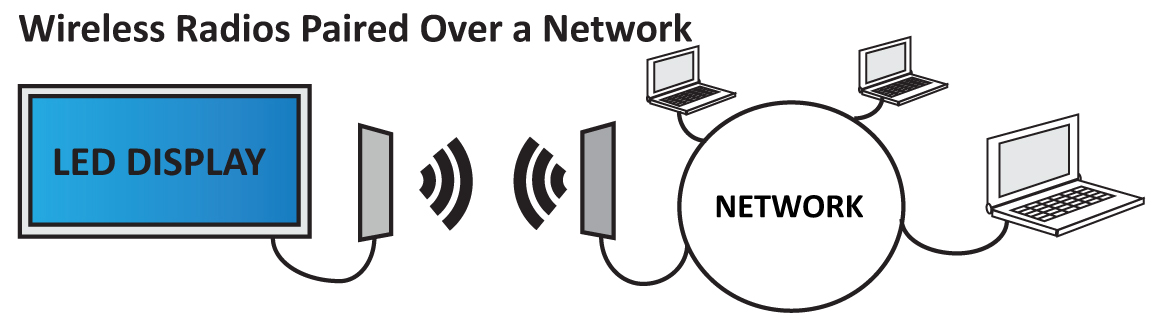
You can get Wireless Radios that connect to serial networks, cellular networks, and standard Ethernet TCP/IP networks. Many frequency standards can be used, but the most common ranges are 900 Mhz, 2.4 Ghz, 5 Ghz and Cellular. Wireless radios have become the standard option for most manufacturers because they allow for a broad range of installation types, and can save time and money by not having to run a hard line in the ground.
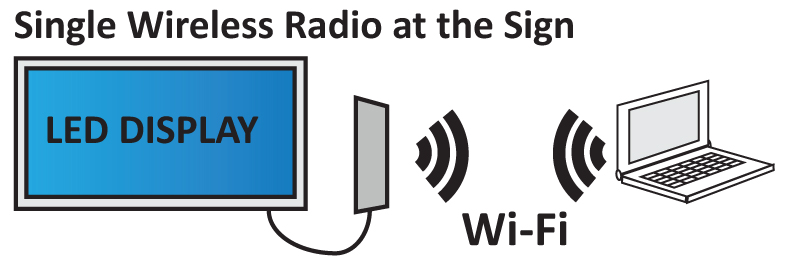
Wireless is best when you have an LED sign that will be within 100-200 yards of the transmission point with clear “Line of Site” (no buildings or metal walls between the radios). The most common configuration is (1) wireless radio installed at the sign, and (1) at the building. You connect the building radio to your network, or computer directly and the radios function as a long wireless “cable” connecting you to the sign. Other configurations can be used depending on the installation like Point to Multipoint, WiFi Access Point, and others.
Common Frequency Types:
900 Mhz (slower data rate, longer distance): These were much more common in the past, when serial networks abundant. However, there are products out there that will use a multi channel 900 Mhz signal with a standard ethernet network to boost the data rate. These radios are best used for installation with special needs like distance or if the signal needs to go through structures between the sign and the transmission point.
2.4 Ghz (standard WiFi frequency): These radios are the most common, and have a good balance of distance and data rate. 2.4 Ghz is the most used frequency in the USA for home and commercial WiFi networks. This poses a slightly larger security risk for your sign, if the radios are not secured properly. (Deacon’s post on LED sign security)
5 Ghz (higher data rate, more secure): This frequency is less common than 2.4 Ghz, making it a bit more secure because most hackers are not looking for signals in the 5 Ghz range. You also avoid possible interference from other 2.4 Ghz devices in the area. Many manufacturers are leaning toward this option as the default choice for LED signs.
Cellular Modem
Another wireless option is a Cellular Modem. These are gaining popularity, but are less commonly used for LED signs. They provide access to the sign over the same data network as your smart phone (3g, 4g, LTE, etc..). Without getting too technical, the system works like this:
After purchasing a “Data Only” monthly plan through a wireless carrier supported by the Cell Modem (ATT, Verizon, T-Mobile, Sprint), the wireless provider will then provide an external internet IP address for the Cell Modem to use. The Cell Modem is installed and connected to the sign (likely using a secured router). You can then send messages to the sign over the internet by using the unique IP address previously provided.
This option is best used for signs that are controlled off-site, in remote locations, or outdoor digital billboards.
WIRELESS AND HARD LINE
I’ve been on installations who utilize both options as a fail-safe measure when the sign is providing mission critical data. This is more common in a military setting, but I’ve seen schools and other government organizations use this approach. For the average user, I believe it’s overkill, but if you do decide to take this route make sure you communicate this to the manufacturer. Some manufacturers will need to put an extra “Network Switch” inside the sign, and this can be an extra fail point. Others will have multiple network ports built into their sign control unit, a much better solution in my opinion.
Conclusion
The bottom line is, make sure you work with the manufacturer or LED sign dealer to get the best solution for your installation. Not being able to communicate with your brand new sign because the communication method is in-correct can really ruin the excitement of the moment. If your manufacturer doesn’t pre-program street ready messages on the sign, you may be stuck with “Sign Test 3” scrolling across the sign until the communication is fixed.
Make sure your manufacturer secures the wireless devices prior to shipment, and allows you to configure them with your own security measures if needed. Communication to your sign is a fundamental necessity, make sure you get the best solution and equipment from your manufacturer.
-Scott Hofheins
I hope this post has been informative and helpful. As usual, I welcome ALL constructive comments. Please feel free to comment and add anything I’ve missed, or additional tips you may have regarding this topic. Please visit www.vantageled.com for many other resources, white papers, and of course: Great looking LED Signs!
**All posts/thoughts/writings are strictly the viewpoint of me and me alone and do not reflect nor speak for Vantage LED’s beliefs, attitudes, thoughts, etc. unless specifically stated.
-Scott Hofheins
I hope this post has been informative and helpful. As usual, I welcome ALL constructive comments. Please feel free to comment and add anything I’ve missed, or additional tips you may have regarding this topic. Please visit www.vantageled.com for many other resources, white papers, and of course: Great looking LED Signs!
**All posts/thoughts/writings are strictly the viewpoint of me and me alone and do not reflect nor speak for Vantage LED’s beliefs, attitudes, thoughts, etc. unless specifically stated.
Tuesday, September 25, 2012
Power Cost of LED Displays
Many very technical people in the Electronic Message Center (EMC) industry, those who are licensed in electrical and in state construction regulations, look the other way and suddenly seem to want to change the subject when this innocent question is asked by a curious customer:
There is no reason to panic! And, better still, this question is a
buying signal. If the customer has gotten this far into their evaluation of a possible
EMC for their business, now is not the time to "freeze up". A great reply to this question may seal the deal for you.
It’s a very simple question to answer and you can start by
calling your power company, or searching online for their price per kilowatt of
power. If you don’t even want to do that, use the average of 10 cents per kilowatt
($.10).
Next determine the power consumption of the EMC in watts.
This information has been provided by the manufacturer. If you do not have the
watt specification then you will have the amperage draw of the EMC.
Remember that Watts = Amps x Voltage. So if you have an EMC rated
at 10 amps, and it is installed in a 110 volt service, you have 10 (amps) x 110 (volts) or 1100
watts of power consumption (per hour).
1100 watts of power is 1.1 kilo Watts of power, of course
kilo means “thousand”. We already determined the cost of power was five cents per kilowatt.
If the customer runs the display non-stop, at peak power, displaying all lamps all of the time for24 hours per day,
then it will cost approximately:
1.1 (kilowatts)
x .10 (cost per kilowatt) x 24
hours = $2.62* per day.
If it is a double-sided EMC, then the cost would double to
$5.24 per day if the EMC ran at maximum output, all the time, no slide transitions, no interruptions, fully illuminated.
Simply
because no EMC, in use by a customer, runs at maximum output all the
time, you should use an very realistic percentage of max power when
estimating average power consumption-- 30% of max. Just tell your
customer to expect about a 1/3rd of maximum cost- even more affordable -
$5.24 x .30 = $1.58* per day!
This is a great investment. What other form of advertising only
costs $1.58 per day for thousands of exposures to thousands of customers
(driving by)? Now you can share this great advertising deal with your
customers- head held high, ready to impress!
Now close that sale!
* Always check with your local power company for peak/ off-peak rates, and understand that this article is a general statement on the subject and not specific to your project.
**Note all posts/thoughts/writings are strictly the viewpoint of me and me
alone and do not reflect nor speak for Vantage LED’s beliefs, attitudes, thoughts, etc. unless specifically stated.
Labels:
advertising,
Digital Display,
Digital Signage,
Electronic Message Center,
EMC Message Center,
high quality,
LED,
LED message center,
LED Sign,
led sign design,
LED System,
Power,
safety,
Sign,
support,
voltage
Thursday, September 20, 2012
LED Sign 101: Myths and Misunderstandings about LED/EMC/Digital Signage
-Deacon Wardlow
Technology is confusing. Looking from the outside-in, one would think the people in technology-sector jobs work hard to keep it that way. NITs, Lux, Flux, EMC, LED, EDS, OOH, DOOH, OA, IC, RJ-45, DVI, HDMI, and the alphabet soup list goes on and on. To clarify things I put together an online (PDF) reference guide (The ABCs of LED Displays); there are still a lot of myths and misunderstandings about LED Signage out there and it almost seems like you need a “Geek Speak” interpreter so here are a few of my favorite myths/misunderstandings simply answered and explained.
LEDs last forever!
That’d be great, but unfortunately, this is not the case. Most LEDs sourced for LED Signage are carefully qualified to last 100,000+ hours (24/7 = 11.4 years, 18/7 = 14.8 years, 12/7= 22.8 years, 8/7 = 34.2 years... a fairly long time for a produced light source!). With proper care and strategic use of heat sinks, it’s possible to get even more optimal lifetime performance before the LED is no longer good. What happens at the end? LEDs don’t really “die” like other light sources. They gradually dim over time. Given enough time, they reach a point where they degrade beyond usefulness (the agreed upon level is less than 70% of the original starting brightness levels = LED “death”).
There’s a bright-light race in the industry and some companies will stoop low to achieve high light levels. Be cautious about manufacturers who tout super bright LEDs, it’s possible they’re overdriving the LED (running a larger amount of power than is recommended and thus increasing the light output, but shortening the lifetime of the LED). Many achieve brightness through fair-play practice, but “caveat emptor” (buyer beware) still reigns out there.
All LED Signs are the same...
With LED signs (as with life) not all things are equal. You’ve got to dig deeper and go beyond the LED. There was a time when due diligence meant what LED is the company using, that’s simply not enough. It’s important to know the LED source is solid and proven to last, but you’ve got to check the other components. Are the power supplies good? How does the manufacturer prevent oxidation on sensitive contacts and leads on the PCB (printed circuit board) in their sign and in the components? Is the software simple to use? Are the communications reliable (and if wireless, do they operate in the 5GHz range as opposed to the 2.4GHz (2.4GHz is more prone to interference)? A knowledgeable salesperson should be able to explain all this and more in easy-to-grasp terminology an show how the overall system performs to meet your needs.
Virtual Resolution is a sham!
This is only true if the manufacturer represents a “virtual” system as containing the same quality as a real pixel (for example a 20mm 64x128 LED sign which is virtualized, saying it’s the same as a 10mm 128x256 LED sign). You can read more on virtualization here.
Size doesn’t matter...
Not true with LED Signage. Make sure what you’re getting quoted is based on the matrix (number of pixels high by number of pixels wide). Some manufacturers and resellers go by size alone. Check this blog on size issues. Systems are rarely standardized across manufacturers and unfortunately this means the retainer (border, if one exists) can be anywhere from 1.5” around the viewing size to 7”. That’s a fairly large difference.
There’s a lot of misdirection and half-truths out there. Please take the time to dig deeper and learn more about the product line before you buy so you’re sure what you’re getting is what you want. A little time spent up front to ensure you’re getting the best system at a fair price will save you a lot of time and money on the back end.
*I invite you to comment here and/or email me directly with requests at deacon@vantageled.com. Vantage LED has white paper resources and more educational material on the website (http://www.vantageled.com), please check it out when you have a moment. Note all posts/thoughts/writings are strictly the viewpoint of me and me alone and do not reflect nor speak for Vantage LED’s beliefs, attitudes, thoughts, etc. unless specifically stated.
Technology is confusing. Looking from the outside-in, one would think the people in technology-sector jobs work hard to keep it that way. NITs, Lux, Flux, EMC, LED, EDS, OOH, DOOH, OA, IC, RJ-45, DVI, HDMI, and the alphabet soup list goes on and on. To clarify things I put together an online (PDF) reference guide (The ABCs of LED Displays); there are still a lot of myths and misunderstandings about LED Signage out there and it almost seems like you need a “Geek Speak” interpreter so here are a few of my favorite myths/misunderstandings simply answered and explained.
LEDs last forever!
That’d be great, but unfortunately, this is not the case. Most LEDs sourced for LED Signage are carefully qualified to last 100,000+ hours (24/7 = 11.4 years, 18/7 = 14.8 years, 12/7= 22.8 years, 8/7 = 34.2 years... a fairly long time for a produced light source!). With proper care and strategic use of heat sinks, it’s possible to get even more optimal lifetime performance before the LED is no longer good. What happens at the end? LEDs don’t really “die” like other light sources. They gradually dim over time. Given enough time, they reach a point where they degrade beyond usefulness (the agreed upon level is less than 70% of the original starting brightness levels = LED “death”).
There’s a bright-light race in the industry and some companies will stoop low to achieve high light levels. Be cautious about manufacturers who tout super bright LEDs, it’s possible they’re overdriving the LED (running a larger amount of power than is recommended and thus increasing the light output, but shortening the lifetime of the LED). Many achieve brightness through fair-play practice, but “caveat emptor” (buyer beware) still reigns out there.
All LED Signs are the same...
With LED signs (as with life) not all things are equal. You’ve got to dig deeper and go beyond the LED. There was a time when due diligence meant what LED is the company using, that’s simply not enough. It’s important to know the LED source is solid and proven to last, but you’ve got to check the other components. Are the power supplies good? How does the manufacturer prevent oxidation on sensitive contacts and leads on the PCB (printed circuit board) in their sign and in the components? Is the software simple to use? Are the communications reliable (and if wireless, do they operate in the 5GHz range as opposed to the 2.4GHz (2.4GHz is more prone to interference)? A knowledgeable salesperson should be able to explain all this and more in easy-to-grasp terminology an show how the overall system performs to meet your needs.
Virtual Resolution is a sham!
This is only true if the manufacturer represents a “virtual” system as containing the same quality as a real pixel (for example a 20mm 64x128 LED sign which is virtualized, saying it’s the same as a 10mm 128x256 LED sign). You can read more on virtualization here.
Size doesn’t matter...
Not true with LED Signage. Make sure what you’re getting quoted is based on the matrix (number of pixels high by number of pixels wide). Some manufacturers and resellers go by size alone. Check this blog on size issues. Systems are rarely standardized across manufacturers and unfortunately this means the retainer (border, if one exists) can be anywhere from 1.5” around the viewing size to 7”. That’s a fairly large difference.
There’s a lot of misdirection and half-truths out there. Please take the time to dig deeper and learn more about the product line before you buy so you’re sure what you’re getting is what you want. A little time spent up front to ensure you’re getting the best system at a fair price will save you a lot of time and money on the back end.
*I invite you to comment here and/or email me directly with requests at deacon@vantageled.com. Vantage LED has white paper resources and more educational material on the website (http://www.vantageled.com), please check it out when you have a moment. Note all posts/thoughts/writings are strictly the viewpoint of me and me alone and do not reflect nor speak for Vantage LED’s beliefs, attitudes, thoughts, etc. unless specifically stated.
Tuesday, September 18, 2012
Finding a Quality Sign Installer for an EMC or LED Sign Project
Finding a good company to install your very expensive LED sign can be challenging. You want to get a good price and high quality work but there are some obstacles to overcome. Some areas have many companies to choose from, others have very few. How do you find the best installer for your money?I would like to share some tips I’ve learned over the years, and hopefully save some time and money for those who are entering the world of LED Signs, Video Boards and Electronic Message Centers.
Research is Key
The internet has provided many sources and ways to research any topic, sign installation included. I’ve listed a few good sources below:
- SignSearch: This site allows you to search for anything sign related, installation included. I usually select “Have a sign installed” and simply put “Pole Sign” or “Wall Sign” in the description field. Companies are then listed, and you can check out their services, contact info and website.
- Google Maps: This is pretty straight forward. Just search your organization's address. Once it pops up on the map, click the “Search Nearby” link, and type “Sign Installation” or something similar. This will show a nice geographic location of businesses in your area that have something to do with signs and/or installation.
- SignWeb: This has some good directories, similar to SignSearch.
Referrals are also a great way to find good installers. Ask your neighbors who they used for their sign installation, and if they had a good experience. Also, your LED sign supplier might have some good contacts for you.
Qualities to Look For
- Equipment “In-House”: I have used several companies in the past that outsourced their entire crew and have done an outstanding job. But for the most part, having cranes, bucket trucks, and installation crews all in-house is preferable. In-house equipment means that scheduling and implementing your installation happens much more quickly than someone who is relying on a third party.
- Sign Company or “Install Only” Company: I have had success with both types of businesses, but I tend to lean toward finding a company who just does installations. If you need fabrication done (pole covers, painting, ect..) in addition to the installation, a sign company that also specializes in installations might be the way to go.
- Experience With LED signs: More and more business are using LED signs, so many installers have at least a little bit of experience with LED signs.
- Licensing and Insurance: Every installer should be licensed and insured in the state/county/city they do work in. Using unlicensed or non-insured installers can cause many long term installation and legal issues. Most installers will give you their license number to verify.
- Fast Communication: How quickly a company responds to a quote request, is often a signal of how quickly they will execute your installation. Avoid installers who never seem to be available via telephone, or email. This can signify a lack of organization that will ultimately affect your installation schedule.
Narrow your search, but try to get quotes from 3-5 different companies.. This will help you get a better feel for a reasonable cost for your installation and give you more chances to see how quickly each company will respond during the quote process.
Make sure to be very clear on the “Scope of Work” for your installation, so there are no unexpected charges. Here are some general items that should be covered:
- Pre-Installation Site Survey: The installer should see the site prior to installation to verify power, access, existing structures, and other important items
- Permits: Are they required? (See my series on permits) If so, who will be pulling them, and how much will it cost. City/County fees vary, but the labor fees for installers to pull permits is usually an hourly rate. In my experience it usually doesn’t go over $300, unless you have to get a special sign variance.
- Installation of the LED Sign: Where will it be going, how high, how many faces, etc...
- Electrical Connection: Most installers will make the final connection to existing power within 5 ft of the sign, as long at there is no digging involved. Make sure this is clear.
- Terms: Layout your expected terms in the quote request. Common terms are 50% down payment, and 50% after the installation is completed.
Once you get the quotes back, take note of the following items:
- Is the price reasonable? Getting more than one quote will help you determine this. If you get (4) quotes back for $2000 and (1) quote back for $600 chances are the low price is either because the installer isn’t quoting the entire scope, or they are under quoting to secure the job, and will increase the cost during or after the installation. The key is to get as many reasonable quotes as possible, to help you get a feel for the “Market Price”.
- How quickly did they get it back to you? Most of the time a 1-2 day turnaround is good. If the quote comes back to quickly, verify that the installer is actually quoting all the work and not just throwing a cheap price out there. If it takes too long, you may want to avoid that particular installer. They might be overly busy, or under organized.
- Does the quote include the entire scope in your original quote request? Double check your quote and make sure you are comparing apples to apples between the quotes.
When securing the final installer, make sure the agreement and scope are very clear. I commonly use the phrase “if it’s not in writing, it doesn’t exist” when talking about any kind of service or agreement between two parties. Make sure you have a clear and complete quote and/or agreement for any installation. Email is useful here, and can serve as a good place to verify and keep pertinent information available.
- Scott Hofheins
* I welcome ALL constructive comments. Please feel free to comment and add anything I’ve missed, or additional tips you may have regarding this topic. Please visit www.vantageled.com for any other resources, white papers, and of course: Great looking LED Signs!
**All posts/thoughts/writings are strictly the viewpoint of me and me alone and do not reflect nor speak for Vantage LED’s beliefs, attitudes, thoughts, etc. unless specifically stated.
Subscribe to:
Posts (Atom)


