Thursday, October 11, 2012

Defending your brand: Cheap Components/LED Sign Systems cost you more than money.

-Deacon Wardlow

Over the years I’ve worked with, bought from, worked-on, serviced, taken-down, sold and installed systems from LED Sign manufacturers all over the world. I’ve been asked to come in on installations to consult and I’ve seen the best of signs and the worst of signs. LED Signs, more than other forms of signage, are particularly unnerving for both the experienced Digital Signage shop and sign shops just getting into the market. The signs are big ticket items and when something goes south, the sign shop who sold the deal is going to hear about it from the customer, their competition and people in the area. They definitely draw attention and the worst kind of attention is from a system which isn’t working properly.

LED Signs are all the same right? not really. If you’ve been following the blog or take a look at past articles like this one you’ll see huge differences. Manufacturers often buyout engineering and software development instead of keeping it in-house. Components are sometimes scaled down and cheaper parts swapped in for “economy lines.” There are a lot of lemons in the apple tree making apples-to-apples comparisons difficult. Even worse, many manufacturers try to create specs around perceived “unique” qualities of their systems which don’t have any relevance to actual system performance. They're parlor tricks meant to divert the buyers attention.

The worst reality of LED signage is a lot of the poorly constructed systems actually look great. Put it up, give it power and it runs like any other; for a month or a year, maybe even two years. Unfortunately, the end-user doesn’t pay out for a 1 year system. The investment is not a small one. Most small businesses will commit a substantial portion of their revenue towards buying an LED sign. It’s a big investment. When that investment fails (starts to look dim, has had five service calls in one month to fix a controller issue, has LED modules which failed and the replacement modules don’t match the color, etc.) it fails spectacularly. 


When I’m going out to eat, I’ll take a look at the sign and if the sign doesn’t look good, I’ll pass the restaurant up. It’s a bit superficial of me but really... Do you want to eat at a place where the owners don’t care enough about their business image to keep the sign looking good... What do you think they’re doing in the kitchen where you can’t see what’s being skimped on? What's the cost of a failing/failed Digital Signage? Beyond the multiple trips out to fix the system and the growing burden on the end-user to pay for the service calls (as most systems aren’t warranted on labor), the reputation takes a big hit.

The reputation you get is the one you’ve earned. The sign industry itself is surprisingly smaller than you’d think. Often I’ve spoken with a sign shop owner in CA who is friends with other sign shop owners in FL and NH. At the national tradeshows, people can point out the shops who cut corners and the ones who refuse to do anything but the best builds (even if the price is high). The reputation you earn is important and unfortunately can be lost in a heartbeat. A lot of pain, suffering, money and bad feelings can be saved by doing a little research now to ensure you’re not buying low-end systems touted as quality. 


I’m not saying the most expensive systems out there are the best, just make sure your investment is made with a company who cares about your reputation and is working hard to ensure both your reputation and theirs continue to grow positively. Saving a few dollars by going with the cheapest thing out there will cost you in more ways than one when the system brings the reality check in for payment. Dig deeper and make sure you're getting what you pay for, a balance of cost-conscious build and solid design/engineering. Don't let a bad sign cost you and your end users hard earned money and reputations. The money can be made back, but a reputation takes a lot longer to recover.


*I invite you to comment here and/or email me directly with requests at deacon@vantageled.com. Vantage LED has white paper resources and more educational material on the website (http://www.vantageled.com), please check it out when you have a moment. Note all posts/thoughts/writings are strictly the viewpoint of me and me alone and do not reflect nor speak for Vantage LED’s beliefs, attitudes, thoughts, etc. unless specifically stated.

Tuesday, October 9, 2012

Quality Control for LED Sign Supply Chains


Anyone who has experienced the unique challenges of trying to source product or components overseas will tell you it is not for the weak spirited. Even Apple, one of the most successful companies in the world today is not immune to troubles with oversea suppliers (see here). The logistical, cultural, linguistic, and engineering aspects of sourcing products overseas do not always align correctly. Although It’s safe to say that virtually every LED sign manufacturer uses some components that are sourced from overseas manufactures in one way or another, not all of them have been able to control the quality of these components effectively. This post is written mainly for sign companies who are considering buying “direct” from overseas suppliers, but it will also be educational for end users who are in the market for an LED sign.

Quality control is hard to manage when you're working with factories that are 7000 miles away. It can be done, but it takes a balanced approach and a major commitment by the US based organization. When you buy from organizations that do this well, you significantly decrease your risk of getting a sub-par product and ultimately save time and money by avoiding lengthy service issues and sign outages. However, when you buy from an organization that does this poorly or manufactures most of their LED sign overseas, the risk of poor quality product increases greatly. Here are some reasons why:

Limited Oversight
US distributors or manufacturers who do not have direct contract with the supplier find themselves completely at the mercy of their quality control system...if one exists at all. It is crucial to have direct contact with the suppliers, the ability to meet face to face, speak the language, and to know the right people. There are a large number of overseas component suppliers, but a smaller number of good suppliers out there. Knowing the right supplier to use, and having a good relationship with them is key to a successful quality control program.

Component Swapping
This is something that continues to plague distributors of overseas products. Mike’s last blog post addressed some important aspects of this issue (see here). Many overseas manufacturers will build the sample product (and even the first production run) with high quality components. The initial product seems to work well, and the distributor puts more orders in. This is where many manufacturers will start to swap out the internal components with less expensive alternatives over time. This is done without notifying the US distributor and the end result is a sub-par product that may work initially, but fail miserably after only 1-2 years of service.

Inconsistent Product
Distributors that do not have the resources to design, engineer, and oversee production find out very quickly that their product will be changed to suite the needs of the overseas supplier, without consultation. Component locations, LED Binning (color grading), connector locations, and physical materials are common areas for unannounced changes.


Multiple Sources
When US manufacturers rely too heavily on a single source for a particular component, they lose the ability to respond to product shortages quickly and effectively. The ability to demand quality control is also diminished if the manufacturer doesn’t have an alternate supplier to go to if the quality suffers.


Over the past 5-6 years, sourcing overseas suppliers has expanded in a way not friendly to the sign distributor, or the end users themselves. Unfortunately many sign companies believed they had found a perfect solution to increase profit margins by “going direct” to an overseas manufacturer. However, they did not realize what it really takes to reliably source, produce, and bring components into the US while maintaining the quality expected by today's consumer.

In my opinion, the best manufacturers commit the resources and spend the money needed to support a solid high quality supply chain. They don’t source the entire production overseas, but only the components that make sense. They develop relationships with the best suppliers, and work with them directly. Controlling the quality of the supply chain is an important aspect of our industry and must be actively addressed by the manufacturer. Doing this effectively benefits everyone, including the end users who ultimately feel the effects of a good, or bad supply chain.


-Scott Hofheins


I hope this post has been informative and helpful. As usual, I welcome ALL constructive comments. Please feel free to comment and add anything I’ve missed, or additional tips you may have regarding this topic. Please visit www.vantageled.com for many other resources, white papers, and of course: Great looking LED Signs!

**All posts/thoughts/writings are strictly the viewpoint of me and me alone and do not reflect nor speak for Vantage LED’s beliefs, attitudes, thoughts, etc. unless specifically stated.

Thursday, October 4, 2012

EMC- Specification Switchout

- Mike Prongue 

Imagine if you will, you are the sales manager at an exclusive automobile dealership specializing in importing Italian sports cars. Brand names are not important for this exercise, but think “red, shiny, fast, 750 horsepower and expensive.”

Your client, Daniel J. Smith, Esq., corporate lawyer for a Fortune 500 company has walked into your 11th Avenue exotic sports car showroom in Manhattan.

“Good morning Don,” Mr. Smith said, extending his hand for a firm shake, his diamond cufflinks showing from under the cuff of his Gieves & Hawkes custom-tailored $4,000 suit. Mr. Smith is 52 years-old and an exacting professional who does not always please easily

“Let me look at my new car,” he said with excitement.

“Well Mr. Smith, we are almost done with the final detailing and it should be ready within the hour, “ you say smiling, “I know you’ve waited three months for this car, and it was hand-assembled to your specification requests.”

“But…” you say, as the showroom clears out and a deathly silence descends.

“They changed the color from red to green, and the 6-speed transmission was replaced with an automatic.”

“No extra charge!” you add, failing in your desperate attempt at levity. You can see the legal papers already being filed at the courthouse.

Of course this type of last minute switch-out would create an issue of apocalyptic proportion and would never be tolerated by the car dealership or any customer.

In the Electronic Message Center (EMC) industry, this happens every day, much more so with imported projects. Manufacturers need not be named as it occurs across a broad spectrum of suppliers.

What does a Sign Company or EMC distributor do when this occurs? What leverage do they have? It seems like very little, actually.

The Sign Company or EMC distributor placed an order in good faith usually after receiving a deposit from the customer. They ordered the project from some supplier, sometimes off-shore, precisely communicating the exact specifications the customer requested, money is wired to begin the project and the final payment is wired before the project ships, usually about 6-weeks later.

The customer is waiting. The EMC comes in and it is the wrong pixel size, has rear opening cabinets instead of front removable modules, or the amber grayscale request has been changed out with a red screen.

Two and a half months have passed since the order was placed and the project is late, having been placed on an extended hold in US Customs at the Long Beach, CA port. Now it must be installed in only 7 days to support the grand opening of an auto parts store. The clock is ticking!

You can’t send it back to China (for example), as it would take at least 4 weeks to get there. What do you do? Make excuses or give the customer a discount? Not good enough to ensure a customer for a week much less a customer for life. There is no good strategy at this point.

You can call and complain and perhaps get a discount on the next order, but then somehow that order is also wrong and now you have two compromised customers and the dysfunction continues.

Project specifications for your order are not wishes- they are a precise requirement. When an order is placed however, it never seems to occur to the Sign Company or EMC distributor that such an egregious error could happen. The Sign Company may never know if the system was manufactured in “error” or if it was actually a pre-built project which had been canceled by some other customer ("close enough" to match the dealer's order). This is called a “switch out”. One never knows, does one?

It is important to know your supplier, have legal recourse, have timely production updates, and a signed sales order showing you exactly what to expect. Ordering an EMC is not game of roulette if you have done your homework by calling references and checking them out. As they say “You get what you inspect, rather than what you expect.”

So, it’s critical to choose wisely and do not become the victim of the “last minute switch out”. It does happen every day in the EMC industry.

Isolated production mistakes with U.S. manufacturers can be rapidly resolved because contract law is honored here and solutions can be shipped rapidly. Rectifying the much more common international situation, perhaps a last-minute “switch out”, is an entirely different problem and for which a good solution remains elusive.

**Note all posts/thoughts/writings are strictly the viewpoint of me and me alone and do not reflect nor speak for Vantage LED’s beliefs, attitudes, thoughts, etc. unless specifically stated.

Tuesday, October 2, 2012

LED Sign 101: Hidden Costs /Issues/What to look for to Identify Quality vs Cheap Components


-Deacon Wardlow

Technology can get very complicated. Once upon a time, it was enough to ask what LED a manufacturer was using for their LED Sign systems, the LED used would be a general qualifier to demonstrate if the manufacturer is using high-end components or cutting corners. With the release of patent-rights with LEDs and improvement of automated systems, this qualifier isn’t enough. It can feel like you need a Doctorate to wade through the technical terms. Have no fear, the “Geek Speak” team is here to help you through.

System specifications are a great place to start your qualification.

Colors:
Start with the number on Colors (you can find the original blog here). It used to be 16.7 Million colors was good, billions was better. Most control systems are now low enough (cost-wise) to allow manufacturers to go high-end without heavy costs required pushing the numbers up to Trillions. The higher the true color value available the better. Higher color values are an indication of higher overall depth of color and overall system performance. Lower values are an indicator the manufacturer is cutting a corner to achieve a lower cost (a few dollars here and there add up in the long run for a manufacturer, but the corner cut means a lower-performing system which will not be ideal for the long term investment being made).

Power Supplies:
I wrote a blog a few months back on this topic. Not only is the type of power supply critically important, but how the manufacturer is driving the power matters as well. Many manufacturers will drive power supplies at about 70-80%. This doesn’t sound bad to most people (they’re using less than 100% right? That’s gotta be good…). Unfortunately, the power supply performance is based on temperature. The hotter a power supply gets, the lower its performance capability. Optimally, a manufacturer should only be drawing upon 50%-60% or less of the power supply’s available power. This ensures the power supply will perform optimally regardless of high temperatures/environment. If a power supply is driven at 80%, the moment heat rises above 85 degrees, the system performance starts dropping. If the power supplies are driven at high values (70-80%) the moment performance drops below the 70/80% mark, the power supply will shut down and cause the system to go blank.

Conformal Coating:
Conformal Coating is incredibly important for the long-term optimal performance of an LED system. Further details are available in a prior blog written last month. When you look at the green PCB (Printed Circuit Board) on the back of an LED module, you’ll see a glossy shine. This should be even without clumps and dull/matte areas. Conformal coating protect sensitive components from oxidation, break-down, and damage from the environment. Poor conformal coating will cut the lifetime performance and expectation on a system down to a third or less.

FPS (Frames Per Second):
Another indicator to check the quality of the controller is refresh rate and FPS. Low values indicate a lower quality system. Baseline FPS should be 40-60 (not lower than 40) with a refresh rate of 1200+Hz). LED Signage is a big investment which will run returns over a decade. While cutting costs with a cheaper controller may appear good in the beginning, the overall performance takes a hit.
 

Hidden Costs:
Conformal coating on power supplies, adding a more robust capacitance to circuit boards, higher-grade chips, etc. are all small incidental costs which add up. Many manufacturers avoid higher-end components figuring the end-user won’t know any better and the performance is still “ok.” Not using proper conformal coating leads to shorter lifetime performance for system critical components which will require replacement.


While these seem like small things, the details are important. When looking at a low-cost alternative or dealing with a manufacturer who carries a second, “cost effective” line, make sure you get a full explanation of how that lower cost is achieved. 
The money the manufacturers saved by not using the best process or product ends-up costing the end-user with premature service calls (which can cost hundreds of dollars a visit) and it can cost the dealer their hard earned reputation as a reliable source for quality solutions. Cutting corners may appear to save some money up front, but will cost in the long term.

*I invite you to comment here and/or email me directly with requests at deacon@vantageled.com. Vantage LED has white paper resources and more educational material on the website (http://www.vantageled.com), please check it out when you have a moment. Note all posts/thoughts/writings are strictly the viewpoint of me and me alone and do not reflect nor speak for Vantage LED’s beliefs, attitudes, thoughts, etc. unless specifically stated.

Thursday, September 27, 2012

Communication Methods for LED Signs / Electronic Message Centers: Wireless, Hard Wired, or Both?


LED Signs communicate information to the public, but how do you decide the best way to communicate to the sign? There are many ways to do this and each option has its own pros and cons, depending on your specific installation type.

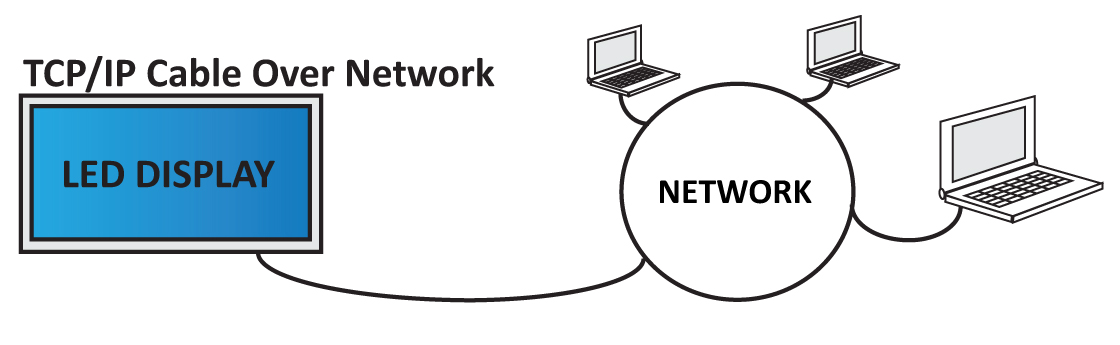
There are (3) types of approaches to communication: wired, wireless, or both. Some locations have existing hard wiring to the sign site, others are more remote and using a cellular modem is the only realistic option.


WIRED (HARD LINE)   
  
In the past, before high speed networks were common, LED signs were usually hardwired using a phone modem or serial cable (RS485 or RS232). These options were fine back then, because the signs were less sophisticated and the actual data sent to the sign was minimal. As LED sign technology expanded, larger file sizes were required. These options became less common and were replaced by standard Ethernet network cable or Fiber Optics. The older options are still used in special situations like factory production floors where they have a large serial network with simple machine code, but for the commercial market Ethernet and Fiber have become the standard wired solution.


Ethernet TCP/IP  (Cat5/6 Cable - RJ45 Ends)

 
This is a common option for wall mounted signs, or street signs that are closer to the building or network drop, where the cable run is less than 300 Ft. Most LED sign manufacturers offer this connectivity imbedded into their system without any special adapters. Signs that require separate “Ethernet Adapters” may be using older Serial based controllers.

  • Maximum run is 300ft without a network switch in the middle to boost the signal.
  • Less fragile than Fiber Optics. Harder to damage.
  • Ethernet networks are very common, and the cable is inexpensive.


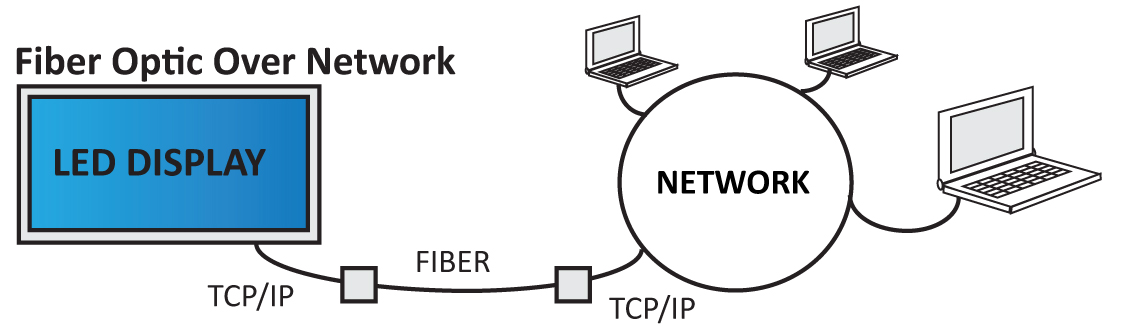
Fiber Optic Cable

 
Although somewhat rare in commercial LED sign installation, Fiber is still commonly used in the military. Data is sent using light signals across refined glass strands that make up the fiber optic cable. An “Fiber Optic to Ethernet” converter is usually required on both sides of the system: one placed at the sign, and the other at the building where it connects to the main Ethernet network.

  • Long distance capability near 40 miles with Single-Mode (more expensive), and 10 miles using Multi-Mode (less expensive).
  • Fragile, and can be expensive to run and repair if damaged.


WIRELESS
  
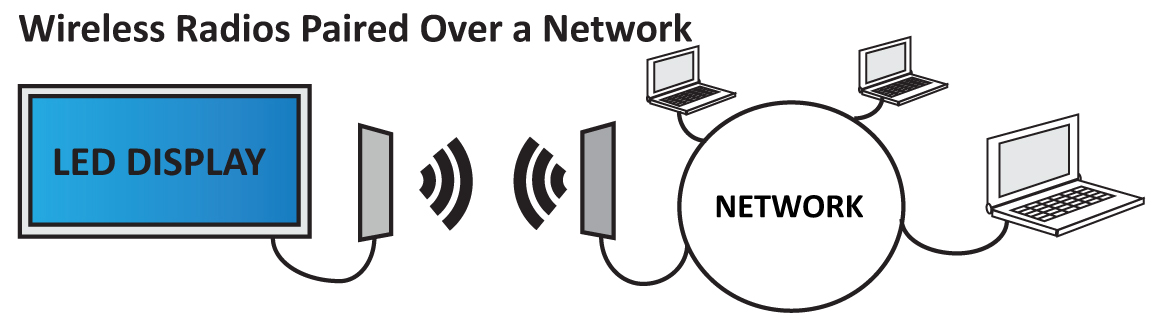
You can get Wireless Radios that connect to serial networks, cellular networks, and standard Ethernet TCP/IP networks. Many frequency standards can be used, but the most common ranges are 900 Mhz, 2.4 Ghz, 5 Ghz and Cellular. Wireless radios have become the standard option for most manufacturers because they allow for a broad range of installation types, and can save time and money by not having to run a hard line in the ground.

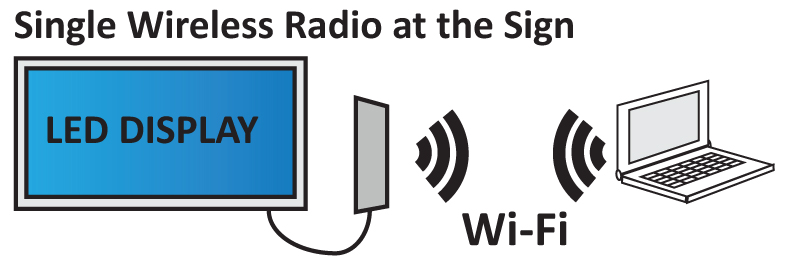
Wireless is best when you have an LED sign that will be within 100-200 yards of the transmission point with clear “Line of Site” (no buildings or metal walls between the radios). The most common configuration  is (1) wireless radio installed at the sign, and (1) at the building. You connect the building radio to your network, or computer directly and the radios function as a long wireless “cable” connecting you to the sign. Other configurations can be used depending on the installation like Point to Multipoint, WiFi Access Point, and others.  


Common Frequency Types:

900 Mhz (slower data rate, longer distance): These were much more common in the past, when serial networks abundant. However, there are products out there that will use a multi channel 900 Mhz signal with a standard ethernet network to boost the data rate. These radios are best used for installation with special needs like distance or if the signal needs to go through structures between the sign and the transmission point.

2.4 Ghz (standard WiFi frequency): These radios are the most common, and have a good balance of distance and data rate. 2.4 Ghz is the most used frequency in the USA for home and commercial WiFi networks. This poses a slightly larger security risk for your sign, if the radios are not secured properly. (Deacon’s post on LED sign security)

5 Ghz (higher data rate, more secure): This frequency is less common than 2.4 Ghz, making it a bit more secure because most hackers are not looking for signals in the 5 Ghz range. You also avoid possible interference from other 2.4 Ghz devices in the area. Many manufacturers are leaning toward this option as the default choice for LED signs.

Cellular Modem

Another wireless option is a Cellular Modem. These are gaining popularity, but are less commonly used for LED signs. They provide access to the sign over the same data network as your smart phone (3g, 4g, LTE, etc..). Without getting too technical, the system works like this:

After purchasing a “Data Only” monthly plan through a wireless carrier supported by the Cell Modem (ATT, Verizon, T-Mobile, Sprint),  the wireless provider will then provide an external internet IP address for the Cell Modem to use. The Cell Modem is installed and connected to the sign (likely using a secured router). You can then send messages to the sign over the internet by using the unique IP address previously provided.

This option is best used for signs that are controlled off-site, in remote locations, or outdoor digital billboards.


WIRELESS AND HARD LINE

I’ve been on installations who utilize both options as a fail-safe measure when the sign is providing mission critical data. This is more common in a military setting, but I’ve seen schools and other government organizations use this approach. For the average user, I believe it’s overkill, but if you do decide to take this route make sure you communicate this to the manufacturer. Some manufacturers will need to put an extra “Network Switch” inside the sign, and this can be an extra fail point. Others will have multiple network ports built into their sign control unit, a much better solution in my opinion.


Conclusion

The bottom line is, make sure you work with the manufacturer or LED sign dealer to get the best solution for your installation. Not being able to communicate with your brand new sign because the communication method is in-correct can really ruin the excitement of the moment. If your manufacturer doesn’t pre-program street ready messages on the sign, you may be stuck with “Sign Test 3” scrolling across the sign until the communication is fixed.

Make sure your manufacturer secures the wireless devices prior to shipment, and allows you to configure them with your own security measures if needed. Communication to your sign is a fundamental necessity, make sure you get the best solution and equipment from your manufacturer.


-Scott Hofheins


I hope this post has been informative and helpful. As usual, I welcome ALL constructive comments. Please feel free to comment and add anything I’ve missed, or additional tips you may have regarding this topic. Please visit www.vantageled.com for many other resources, white papers, and of course: Great looking LED Signs!

**All posts/thoughts/writings are strictly the viewpoint of me and me alone and do not reflect nor speak for Vantage LED’s beliefs, attitudes, thoughts, etc. unless specifically stated.

Tuesday, September 25, 2012

Power Cost of LED Displays

- Mike Prongue 

Many very technical people in the Electronic Message Center (EMC) industry, those who are licensed in electrical and in state construction regulations, look the other way and suddenly seem to want to change the subject when this innocent question is asked by a curious customer:
“What will this cost me to run?”
There is no reason to panic! And, better still, this question is a buying signal. If the customer has gotten this far into their evaluation of a possible EMC for their business, now is not the time to "freeze up". A great reply to this question may seal the deal for you.
It’s a very simple question to answer and you can start by calling your power company, or searching online for their price per kilowatt of power. If you don’t even want to do that, use the average of 10 cents per kilowatt ($.10).
Next determine the power consumption of the EMC in watts. This information has been provided by the manufacturer. If you do not have the watt specification then you will have the amperage draw of the EMC.
Remember that Watts = Amps x Voltage. So if you have an EMC rated at 10 amps, and it is installed in a 110 volt service, you have 10 (amps) x 110 (volts) or 1100 watts of power consumption (per hour).
1100 watts of power is 1.1 kilo Watts of power, of course kilo means “thousand”. We already determined the cost of power was  five cents per kilowatt.
If the customer runs the display non-stop, at peak power, displaying all lamps all of the time for24 hours per day, then it will cost approximately:

1.1 (kilowatts)   x   .10 (cost per kilowatt)  x   24 hours   =   $2.62* per day.

If it is a double-sided EMC, then the cost would double to $5.24 per day if the EMC ran at maximum output, all the time, no slide transitions, no interruptions, fully illuminated.

Simply because no EMC, in use by a customer, runs at maximum output all the time, you should use an very realistic percentage of max power when estimating average power consumption-- 30% of max. Just tell your customer to expect about a 1/3rd of maximum cost- even more affordable - $5.24 x .30  =  $1.58* per day!
This is a great investment. What other form of advertising only costs  $1.58 per day for thousands of exposures to thousands of customers (driving by)? Now you can share this great advertising deal with your customers- head held high, ready to impress!
Now close that sale!

* Always check with your local power company for peak/ off-peak rates, and understand that this article is a general statement on the subject and not specific to your project.

**Note all posts/thoughts/writings are strictly the viewpoint of me and me alone and do not reflect nor speak for Vantage LED’s beliefs, attitudes, thoughts, etc. unless specifically stated.


Thursday, September 20, 2012

LED Sign 101: Myths and Misunderstandings about LED/EMC/Digital Signage


-Deacon Wardlow

Technology is confusing. Looking from the outside-in, one would think the people in technology-sector jobs work hard to keep it that way. NITs, Lux, Flux, EMC, LED, EDS, OOH, DOOH, OA, IC, RJ-45, DVI, HDMI, and the alphabet soup list goes on and on. To clarify things I put together an online (PDF) reference guide (The ABCs of LED Displays); there are still a lot of myths and misunderstandings about LED Signage out there and it almost seems like you need a “Geek Speak” interpreter so here are a few of my favorite myths/misunderstandings simply answered and explained.

LEDs last forever!
That’d be great, but
unfortunately, this is not the case. Most LEDs sourced for LED Signage are carefully qualified to last 100,000+ hours (24/7 = 11.4 years, 18/7 = 14.8 years, 12/7= 22.8 years, 8/7 = 34.2 years... a fairly long time for a produced light source!). With proper care and strategic use of heat sinks, it’s possible to get even more optimal lifetime performance before the LED is no longer good. What happens at the end? LEDs don’t really “die” like other light sources. They gradually dim over time. Given enough time, they reach a point where they degrade beyond usefulness (the agreed upon level is less than 70% of the original starting brightness levels = LED “death”).

There’s a bright-light race in the industry and some companies will stoop low to achieve high light levels. Be cautious about manufacturers who tout super bright LEDs, it’s possible they’re overdriving the LED (running a larger amount of power than is recommended and thus increasing the light output, but shortening the lifetime of the LED). Many achieve brightness through fair-play practice, but “caveat emptor” (buyer beware) still reigns out there.

All LED Signs are the same...
With LED signs (as with life) not all things are equal. You’ve got to dig deeper and go beyond the LED. There was a time when due diligence meant what LED is the company using, that’s simply not enough. It’s important to know the LED source is solid and proven to last, but you’ve got to check the other components. Are the power supplies good? How does the manufacturer prevent oxidation on sensitive contacts and leads on the PCB (printed circuit board) in their sign and in the components? Is the software simple to use? Are the communications reliable (and if wireless, do they operate in the 5GHz range as opposed to the 2.4GHz (2.4GHz is more prone to interference)? A knowledgeable salesperson should be able to explain all this and more in easy-to-grasp terminology an show how the overall system performs to meet your needs.

Virtual Resolution is a sham!
This is only true if the manufacturer represents a “virtual” system as containing the same quality as a real pixel (for example a 20mm 64x128 LED sign which is virtualized, saying it’s the same as a 10mm 128x256 LED sign). You can read more on virtualization here.

Size doesn’t matter...
Not true with LED Signage. Make sure what you’re getting quoted is based on the matrix (number of pixels high by number of pixels wide). Some manufacturers and resellers go by size alone. Check this blog on size issues. Systems are rarely standardized across manufacturers and unfortunately this means the retainer (border, if one exists) can be anywhere from 1.5” around the viewing size to 7”. That’s a fairly large difference.

There’s a lot of misdirection and half-truths out there. Please take the time to dig deeper and learn more about the product line before you buy so you’re sure what you’re getting is what you want. A little time spent up front to ensure you’re getting the best system at a fair price will save you a lot of time and money on the back end.

*I invite you to comment here and/or email me directly with requests at deacon@vantageled.com. Vantage LED has white paper resources and more educational material on the website (http://www.vantageled.com), please check it out when you have a moment. Note all posts/thoughts/writings are strictly the viewpoint of me and me alone and do not reflect nor speak for Vantage LED’s beliefs, attitudes, thoughts, etc. unless specifically stated.